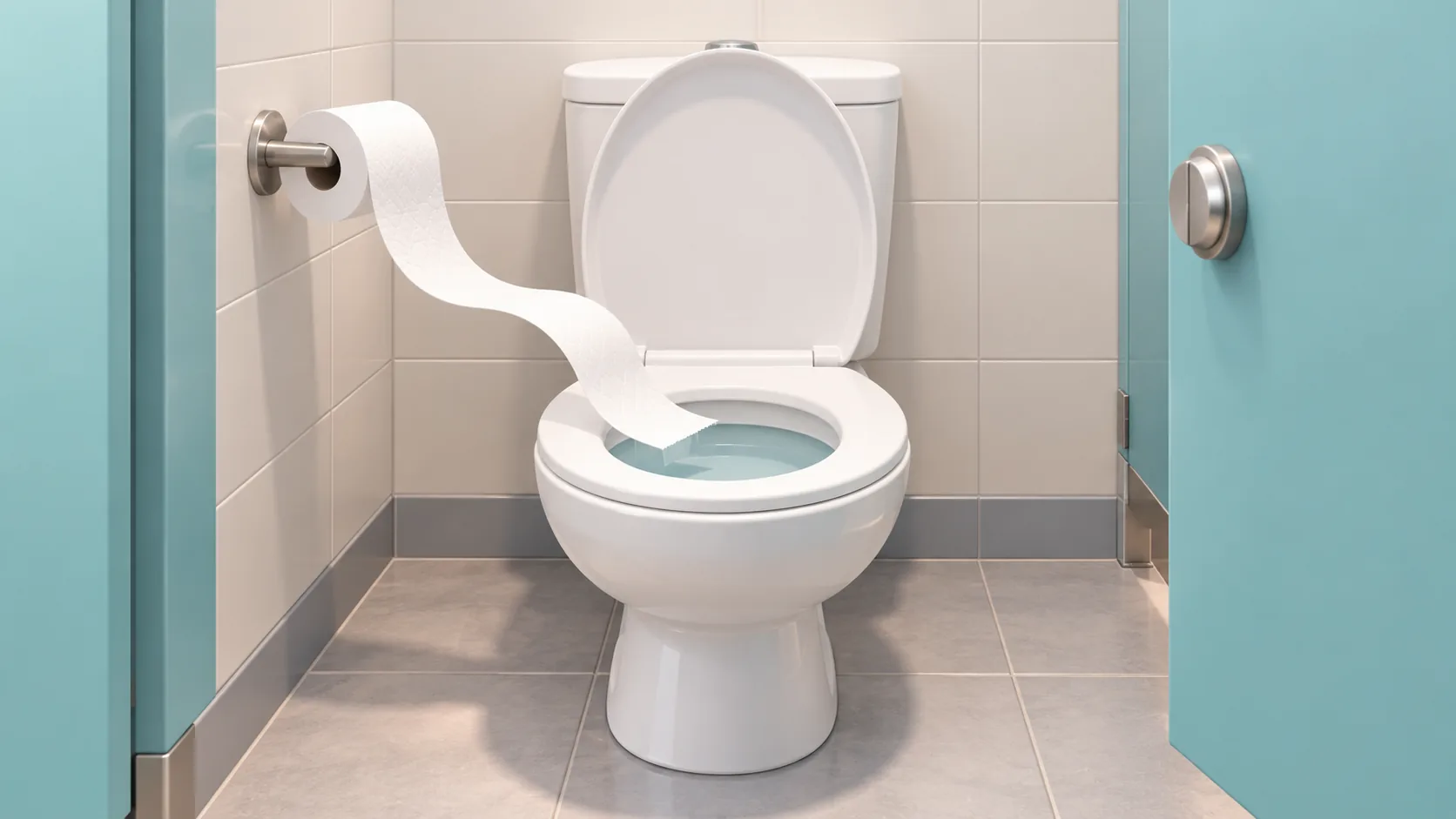
Open a stall in a Korean public toilet and you may notice what is missing: an ordinary waste bin. That empty patch of floor is not necessarily an oversight. Under Korea’s current management standards for covered public toilets, a regular bin should not be placed inside the stall. Used toilet paper goes into the toilet bowl instead.
There is an important distinction. A container in a women’s stall may be a wisaengyongpum sugeoham (위생용품 수거함), a collector for sanitary products. That collector does not invite users to put used toilet paper there. The practical rule is simple: toilet tissue goes in the toilet; sanitary products go in their dedicated collector.
The no-bin rule began in 2018
The Ministry of the Interior and Safety announced the change in December 2017, before it took effect on January 1, 2018. Its public campaign told users that waste bins would disappear from stalls in public toilets and that used toilet paper should be put in the toilet. It also explained that women’s stalls would receive separate sanitary-products collectors.
That date matters because older advice about Korean bathrooms can preserve the opposite habit. A visitor may have learned to look for a bin beside the toilet and assume paper must go there. For a gongjung hwajangsil (공중화장실), meaning a public toilet governed by the relevant rules, that is no longer the official instruction.
Seoul’s current etiquette guidance makes the same point directly. It asks users to put used toilet paper in the toilet and says that discarding it in a bin contributes to dirt and odor. In other words, a bin-free stall is part of the intended cleanliness standard, not a puzzle the user must solve.
The container you see may serve a different purpose
The present enforcement rule separates ordinary rubbish from sanitary waste. It says that a waste bin should not be placed inside a toilet stall. It also requires a sanitary-products collector in a women’s stall, apart from limited cases such as a toilet intended only for children.
This is why “there is a bin” is not enough information. Look at what the container is for. A small lidded collector in a women’s stall may be there for sanitary products, while used toilet tissue still belongs in the toilet.
The distinction also prevents a risky overgeneralization. The official sources specifically say used toilet paper. They do not turn wet wipes, diapers, sanitary pads, or other rubbish into flushable items. The thing is, if an item is not toilet tissue, the no-bin rule does not make it flushable.
Two exceptions explain some ordinary bins
The current rule lists two situations in which an ordinary waste bin may be placed inside a stall:
- a toilet intended for disabled people, older adults, or pregnant people;
- a stall equipped with a diaper-changing table.
Those exceptions are practical rather than contradictory. They account for waste that may be produced while using an accessible facility or changing a diaper. Seeing a bin in one of those stalls does not cancel the general rule for other stalls.
The reverse is also worth remembering: the absence or presence of a bin alone cannot prove a facility’s legal classification or compliance. The rule concerns public toilets within its scope, so it should not be expanded into a claim about every restroom in every private business.
What to do in the stall
Use this quick decision:
- Put ordinary used toilet paper in the toilet.
- Put sanitary products in the designated collector, when provided.
- Don’t flush wipes, diapers, pads, or unrelated rubbish.
- If the stall is accessible or has a diaper-changing table, an ordinary bin may be present under the stated exception.
The useful clue is not simply “bin or no bin.” It is the type of stall and the purpose of the container. Once those are separated, the Korean rule is much easier to follow.
Sources
- Korean Law Information Center: current public-toilet management standards (checked October 4, 2026)
- Ministry of the Interior and Safety: 2017 campaign before the rule took effect (checked October 4, 2026)
- Easy Law: practical explanation of stall-bin rules and exceptions (checked October 4, 2026)
- Seoul Metropolitan Government: public-restroom etiquette (checked October 4, 2026)