
You step off the train and realize your bag is still on the seat. The lost-property website gives you two similar-looking options: 분실물 and 습득물.
One is about things people have lost. The other is about things someone has found. To look for a bag already handed in, start with 습득물 검색, the found-items search. Opening a list of other passengers’ loss reports won’t tell you whether a station has your bag.
If you’ve only just stepped off the train, speak to station staff first. You can search the website afterward.
Give staff the journey, not just the bag’s color
Seoul Metro Line 9’s instructions ask you to remember when and where you got off, your direction of travel and the train type. If you know the train number, keep that too. Report the loss to station staff or the customer support center.
On your phone, write down what you remember before searching other pages. A station name alone leaves a lot unresolved: which direction, which departure, which part of the train? “Yellow bag, Line 9” is less useful than those details together. Don’t fill gaps with guesses; say when you aren’t sure.
You can show staff this sentence:
방금 내린 열차에 가방을 두고 내렸어요. 찾는 걸 도와주실 수 있나요?
I left my bag on the train I just got off. Could you help me find it?
This is a suggested phrase, not an official reporting form. Add the time, station and direction underneath it. If the item was a phone, replace 가방 with 휴대폰.
Open the list of things already found
Line 9 currently links to Police Minwon24. Its direct found-items search opens a Korean search form. The search form is public. Opening it does not complete a loss report.
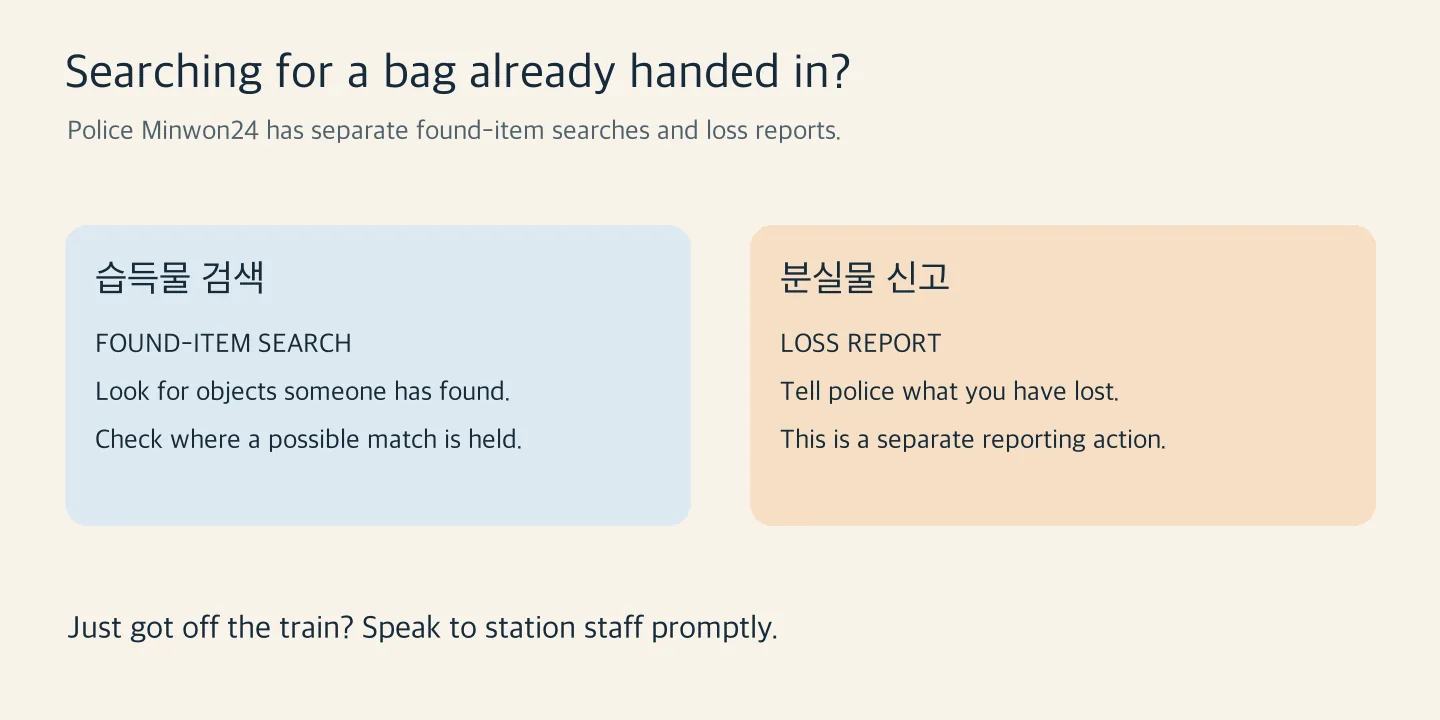
Choose the left-hand path to look for a recovered bag. Filing a report is a separate action.
The form uses 습득일자 for the date the item was found and 습득지역 for the region. 보관장소 means where it is being held. That last field is easy to confuse with the place you lost it. A bag can move after you leave the train.
Start with the item category, a sensible date range and region. If nothing appears, try fewer filters before concluding it isn’t there. A narrowly entered product name assumes the person recording the item used the same wording you would. Searching a broader category avoids that extra assumption. An empty search result alone cannot tell you what happened to the bag.
Before traveling across Seoul to collect it
Call the location holding a possible match and confirm the item and collection arrangements. Line 9 lists its Dongjak lost-property center at 02-2656-0999, open weekdays from 10 a.m. to 7 p.m., excluding weekends and public holidays. Those are that center’s hours, not a timetable for every subway station or lost-property office.
If you cannot find the item, the police portal also provides loss-report instructions. They list online and in-person routes and no application fee. The service concerns lost property and explicitly excludes theft. If online identity verification is a problem, the page names police stations and local police offices as places to report in person.
Keep any candidate item’s management number beside the holding location and phone number. That gives you something specific to ask about, even if your Korean description of the bag is limited to its color.
Links and Line 9 details checked October 11, 2026. Illustrations are explanatory, not screenshots or evidence of a recovered item.