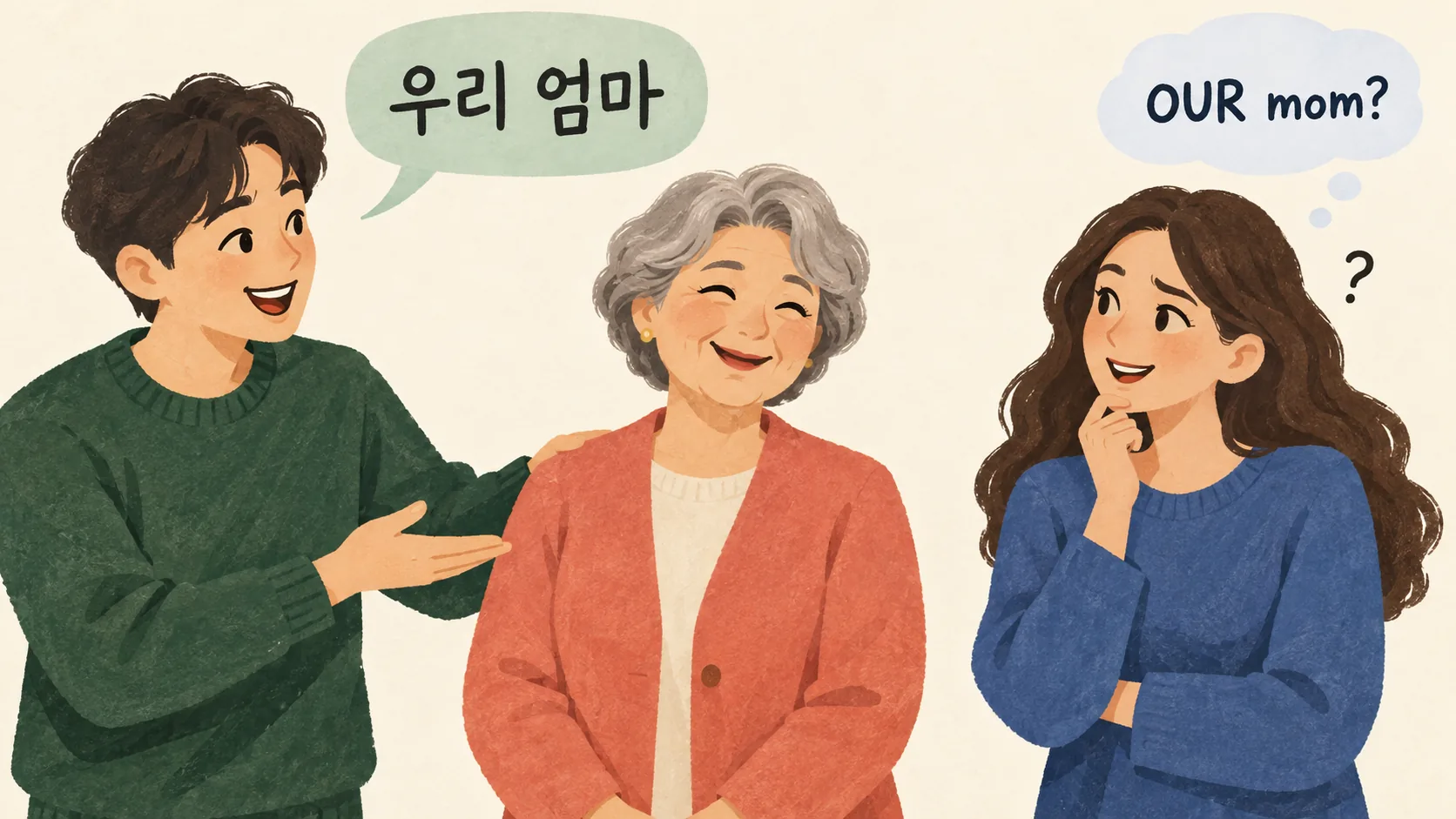
A Korean friend points to a family photo and says 우리 엄마, uri eomma. Word by word, that looks like “our mom.” In this imagined conversation, the English you’d want is “my mom”. No surprise sibling has entered the story.
Now imagine the same person saying it to their own sibling. “Our mom” can fit perfectly. The Korean phrase stayed the same; the people in the conversation changed.
That’s the useful question when you meet 우리: who shares this relationship, and does the listener belong to that group? Translating every occurrence as “our” gives the English reader information the Korean speaker may never have intended.
Keep the sentence; change the listener
The NSW education department’s Korean coursebook gives examples including one’s mother, home and school. It specifically notes that a speaker can use 우리 학교 even with someone who does not attend that school.
Hearing “our school” in a literal translation doesn’t establish that both characters went there. You need the surrounding conversation to know.
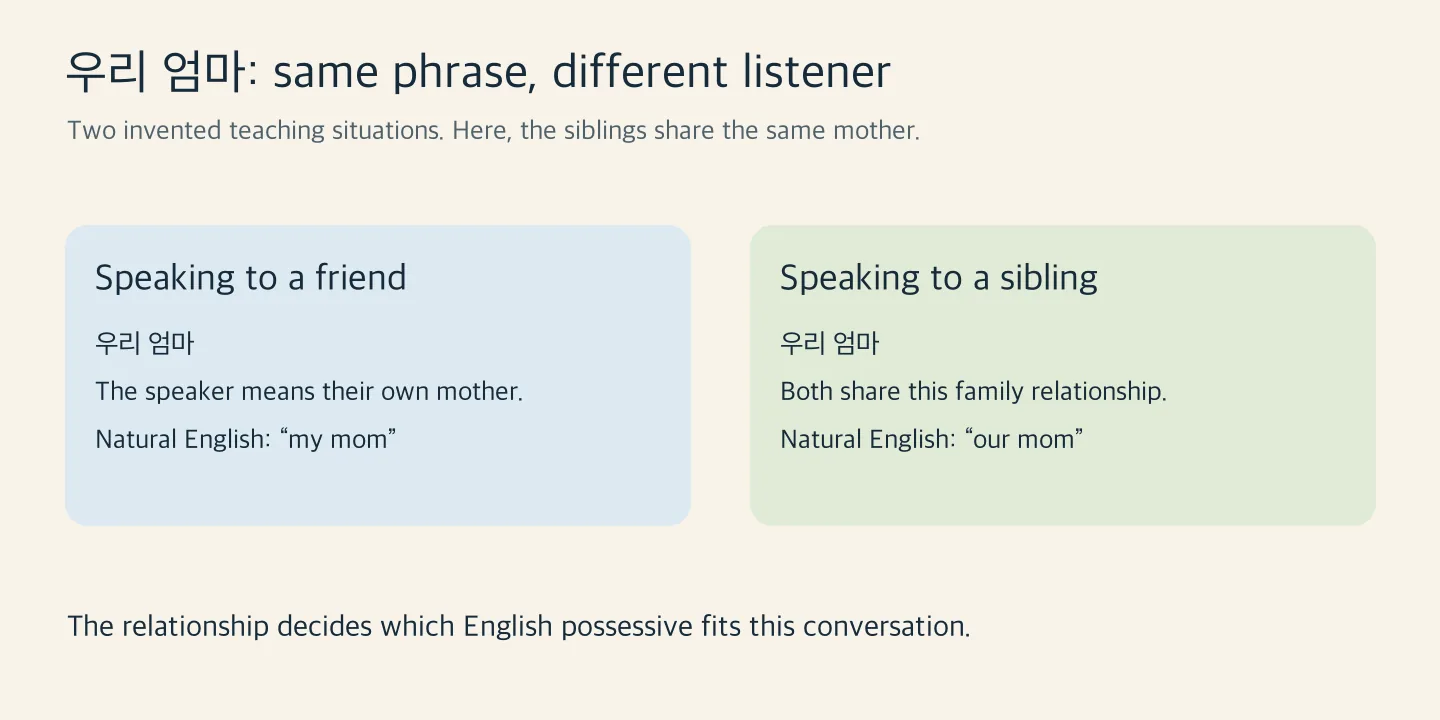
These are teaching examples, not quotations from a real conversation. Both English readings depend on the relationships shown.
Try this while watching a drama: pause at an 우리 phrase and identify the speaker, the person addressed, and the family or group being discussed. Then choose the English possessive. If you still can’t identify the relationship, keep that uncertainty instead of inventing a connection between characters.
“Koreans are collectivist” doesn’t finish the explanation
The coursebook connects this usage to family and community life. That’s an explanation you’ll encounter. It isn’t the only analysis.
In a 2020 paper on singular uses of 우리, philosopher Joongol Kim examines competing accounts and argues that expressions such as 우리 마누라 can function as courteous alternatives to 내 마누라, “my wife”. His account emphasizes polite expression rather than treating the construction as evidence of collectivism.
That is the paper’s argument, not a settled verdict on why every speaker chooses the word. The disagreement matters because a neat cultural story can become a bad translation rule. Neither “always means a shared group” nor “always means my” will handle all the examples above.
I would learn the familiar combinations in context before trying to explain a whole society through one pronoun.
Introducing your mother to a teacher?
There is a second issue beyond “my” versus “our”: how politely to speak to the listener. A question answered by the National Institute of Korean Language asks whether 우리 or 저희 is appropriate when introducing family to classmates or a teacher.
The answer doesn’t prescribe one expression for every introduction. It points to the relationship, closeness and situation. For someone uncomfortable navigating the relative politeness toward both teacher and mother, it suggests an introduction using 제 어머니, “my mother”, with an honorific sentence.
So a reasonable study note is two lines long: “우리 엄마 can refer to the speaker’s mother; check who is listening.” Below it, keep the actual introduction you want to use, including its polite ending. Memorizing just 우리 = our would miss both the translation and the social choice.
Sources checked October 11, 2026. The coursebook is an English-language PDF; the linked Korean answer and research abstract are publicly readable. Archive date assigned during an October 11 catch-up publication.