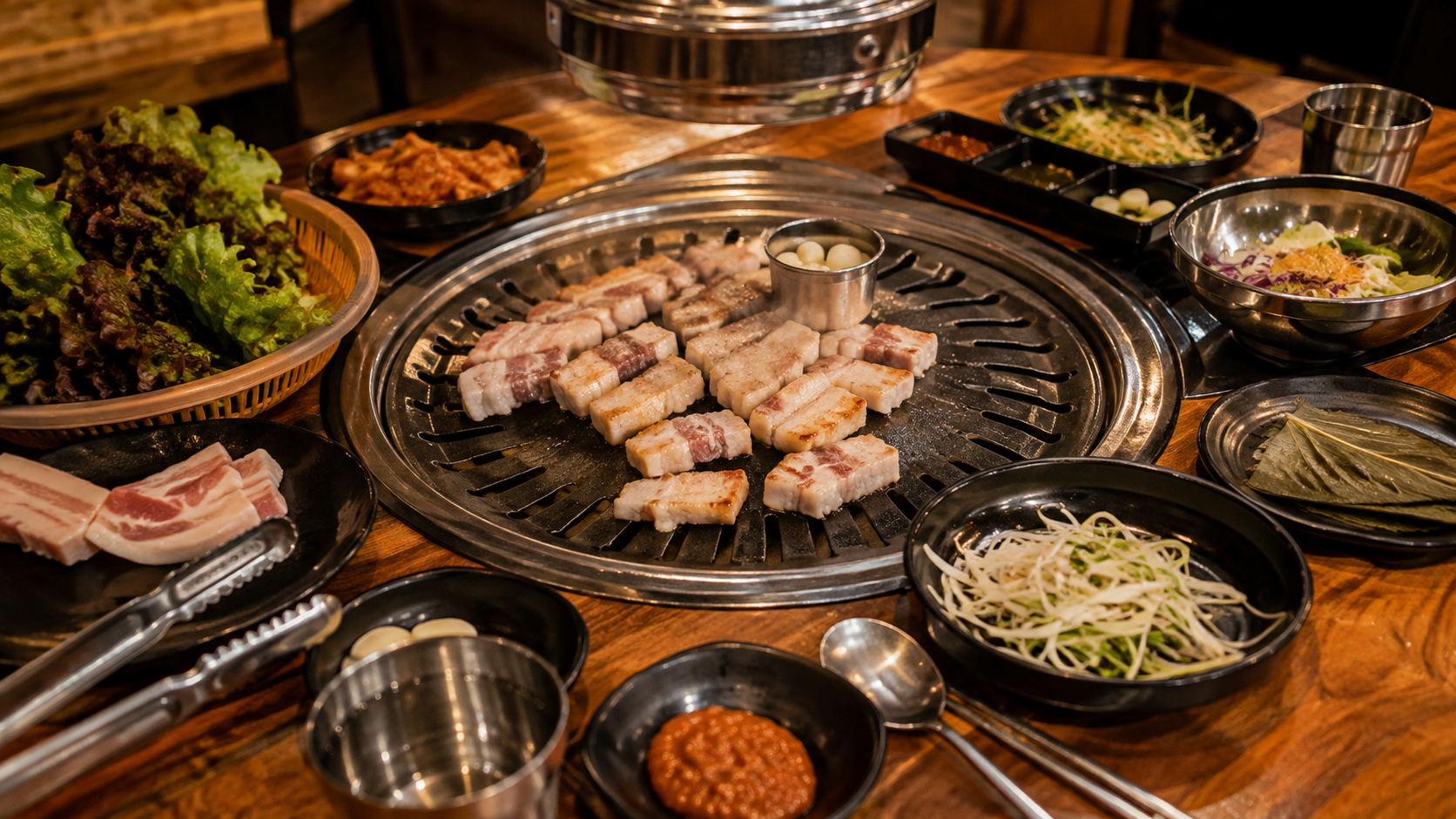
Somewhere in the middle of a Korean barbecue dinner, the samgyeopsal (삼겹살, “three-layer flesh”) gets flipped too early, and somebody reaches over for the tongs with some version of “move, I’ll do it.” It isn’t always the youngest person at the table. Often enough it’s one of the older people, tongs in one hand and scissors in the other.
That line is practically the signature of Korean meat culture, and I think the little fight over the jipge (집게, “tongs”) explains Korean barbecue better than any guide to cuts. The whole format was built for the customer to cook, so the question worth answering on a first visit isn’t pork or beef. It’s whether this restaurant has taken the grill away from you.
It started with a portable burner
Koreans ate pork belly long before anyone grilled it at the table. A 1934 Dong-A Ilbo article already rated the belly as the tastiest part of the pig, under the name segyeopsal, which also means “three layers.” A 1972 newspaper recipe braised it, and in a 1975 article, belly came up as the cut bacon is made from.
Grilling it yourself started outside restaurants. A 2018 piece in the magazine of Korea’s heritage agency dates the shift to after the late 1970s, when per-capita income passed $1,000 and handy portable gas burners arrived. By the mid-1980s more families had cars, and people loaded a burner and an icebox of chilled pork into the trunk and grilled belly by rivers and on mountains all over the country.
Mashija, a food and drink magazine, made a similar point in 2022: the portable burner is what turned grilling meat into a habit, and the restaurants grew up around that habit. So what’s on the table is basically a home setup. A heat source, raw meat, scissors, tongs, and whoever happens to be sitting there. Which is why, honestly, the grill shouldn’t make anyone nervous. It’s a setup meant for amateurs.
Why some restaurants take the tongs
Some places grill for you. A staff member comes back with tongs and scissors, cooks and cuts, and tells you when it’s ready. Then you build your ssam (쌈, “wrap”), a leaf with a piece of meat and a dab of ssamjang, and eat it in one bite.
That’s a business call, and the 2022 magazine piece lays out the trade plainly. If customers grill, the same meat tastes different at every table depending on who’s holding the tongs. If staff grill, the quality stays even, but you need more people on the floor, and the writer warned that could be fatal for a restaurant given how short-staffed the industry has become.
At least one chain treats grilling as a credential now. In November 2025, a pork-grill franchise started testing its store owners for a “grill master” certification, with a written exam and a practical graded on things like preheating the plate for each cut.
If someone from the staff shows up with tongs, let them have the grill. It’s what the restaurant is paying for. If nobody comes, the grill’s yours, and I’d hand the tongs to whoever at your table clearly cares the most. There’s usually one. Then comes the argument over whether kimchi goes on the grill with the meat or after it. I’m on the with-the-meat side, for what it’s worth.
The table with nobody to argue with
The exception is the solo barbecue restaurant. A Hankyung reporter described one in Seoul’s Jung-gu in August 2025: one-person seats in a row along the wall, thin dividers between them, and customers with earphones in, each grilling meat on a small plate of their own.
Sources
- Korea Heritage Service, Monthly Heritage: The comedy-like legend of grilled pork belly (Korean, 2018)
- Mashija: The secret of meat restaurants that do well (Korean, 2022)
- ABC News Korea: A pork-grill chain launches a grill master certification (Korean, 2025)
- Hankyung: Solo diners fill one-person barbecue restaurants (Korean, 2025)
- Korea Tourism Organization: About Korean Food