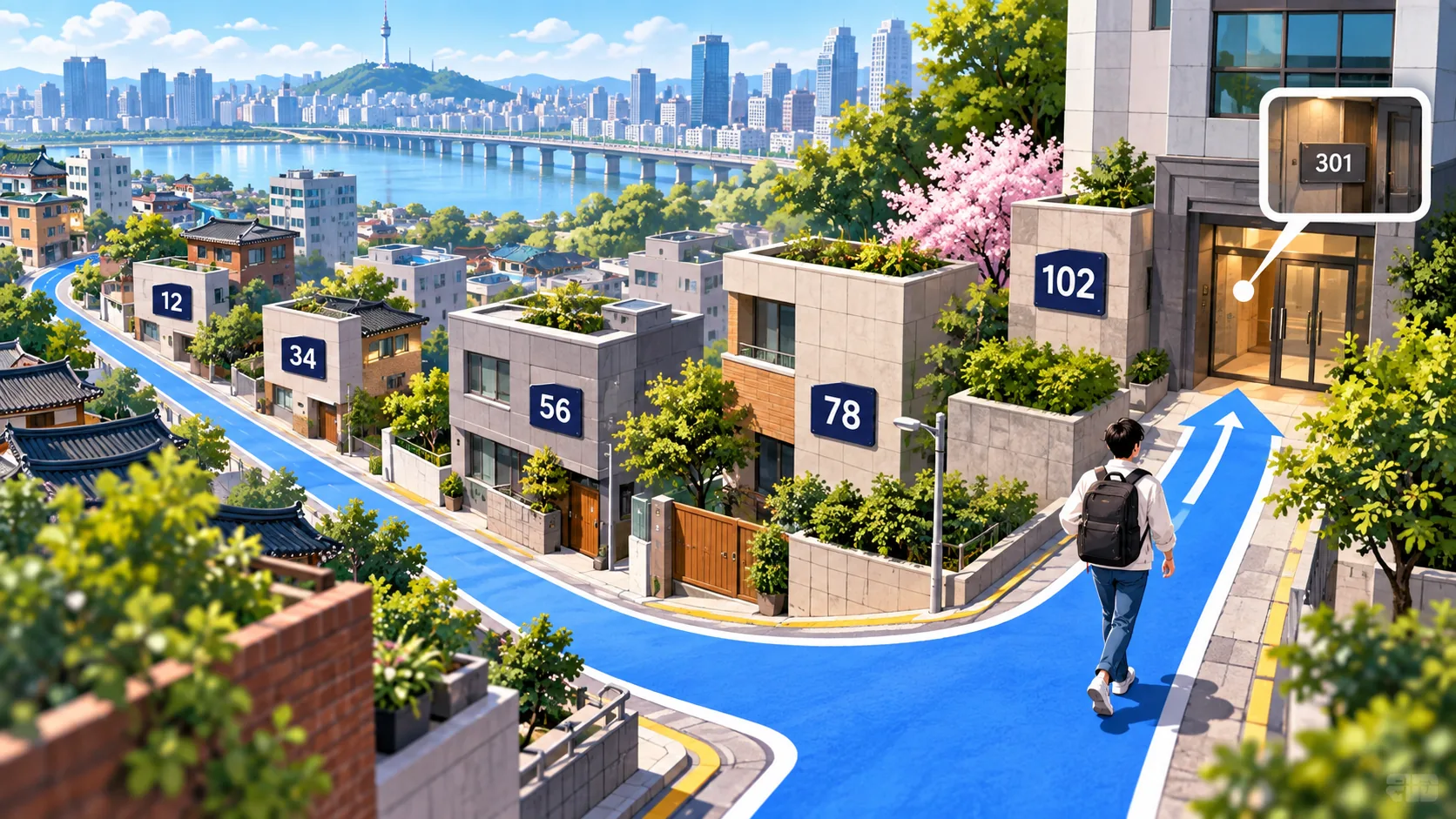
When a Korean address is written in English, the most useful first move is not to translate every word. Separate the address into the road name, the building number, and the final detail that identifies an apartment, floor, or room. Korea’s road-name address system is designed around those pieces, so a line such as “Seongnae-ro 25” is not a decorative translation. It is a route name followed by a number that locates a building along that route.
The road name is the spine of the address
The Korean road-name address guidance from Yangpyeong County describes an address as a combination of a road name, a basic number, a building number, and a detailed address. In plain terms, the road name tells you which named stretch of road to follow. That is different from a business name or a nearby landmark: the address still works when a shop changes its sign.
The road-name system also explains why Korean addresses can look unfamiliar to someone used to a neighborhood-first format. The road is the stable reference, while the rest of the line narrows the destination. You can read the beginning as the map’s route and the later pieces as the building and its internal destination.
Building numbers are not apartment numbers
The address information portal, 주소정보누리집, explains that a building number identifies a building’s location and is assigned at 20-metre intervals from the start of the road. It also describes the odd-and-even pattern: numbers on the left side of the road use one parity and numbers on the right use the other. The practical result is that a number such as 25 is a position along a named road, not a promise that the building has 25 apartments.
That distinction prevents a common reading error. In “Seongnae-ro 25, 000-dong, 000-ho,” 25 is the building number. The dong and ho portion is a separate detailed address inside a building or complex. If a courier asks for the unit detail, repeating the road number is not enough; the last line carries the information that distinguishes one door from another.
The number is also not a floor number by default. A floor or unit marker appears in the detailed-address part when the building uses one. Treating every number as a floor is an understandable guess, but it is not what the road-name rule says.
What the older lot address is doing there
You may still see a Korean address written with a neighborhood name and a lot number. That is a 지번주소, or lot-based address. It can remain useful for records and maps, but it is a different reference from the road-name address. Do not splice a lot number into a road-name line as if it were a second building number. When a form requests the road-name address, enter the road name and building number shown by the address service; when it requests the lot address, use that separate record.
The safest habit is to copy the exact version returned by the official address search instead of converting between the two systems by intuition. Gangdong District’s address page directs residents to its road-name-address and postal-code search, which is a reminder that the authoritative lookup is a service, not a guessing exercise. It is especially useful when a building has a detailed unit line or a newer name that is easy to mistype.
Reading the Roman letters
For visitors and international forms, the Roman-letter road name is part of the same system. Seoul’s official guidance says road names follow the national Romanization rules, keep the name together, and use a hyphen before the road-type ending: “Gangnam-daero,” “Gagok-ro,” and “Balsan-gil” are the examples on the page. The endings are meaningful labels, not interchangeable English words. A form that asks for the address in Roman letters should preserve the official spelling and hyphenation rather than inventing a translation such as “Gangnam Avenue.”
This is where two kinds of uncertainty should stay separate. You can be unsure how to pronounce a Korean road name and still copy its official Roman letters accurately. You can also know the road name but still be missing the building’s unit detail. The first problem is transcription; the second is an incomplete destination.
A short, reliable reading order
When you receive a Korean address, read it in this order:
- Find the road name, usually ending in 대로, 로, or 길, or in its Romanized form -daero, -ro, or -gil.
- Read the following building number as the location along that road.
- Keep the postal code with the address, but do not treat it as a building or apartment number.
- Look for the detailed address: a building name, 동, 층, 호, or another unit description.
- If two versions are shown, label one as road-name address and the other as lot address instead of mixing them.
The point is not to memorize a national address table. It is to respect the job each field performs. The road name gets you to the correct route, the building number selects a building along it, and the detailed address identifies the destination inside. Romanization helps an English-language form display the route; it does not replace the Korean address record.
Korean addresses become much less mysterious once those roles are kept apart. Use the official lookup when a number or unit is uncertain, copy the published Roman letters when a form asks for them, and leave lot-based and road-name addresses as two distinct references. That is enough structure to read the line accurately without pretending that every number in it means the same thing.