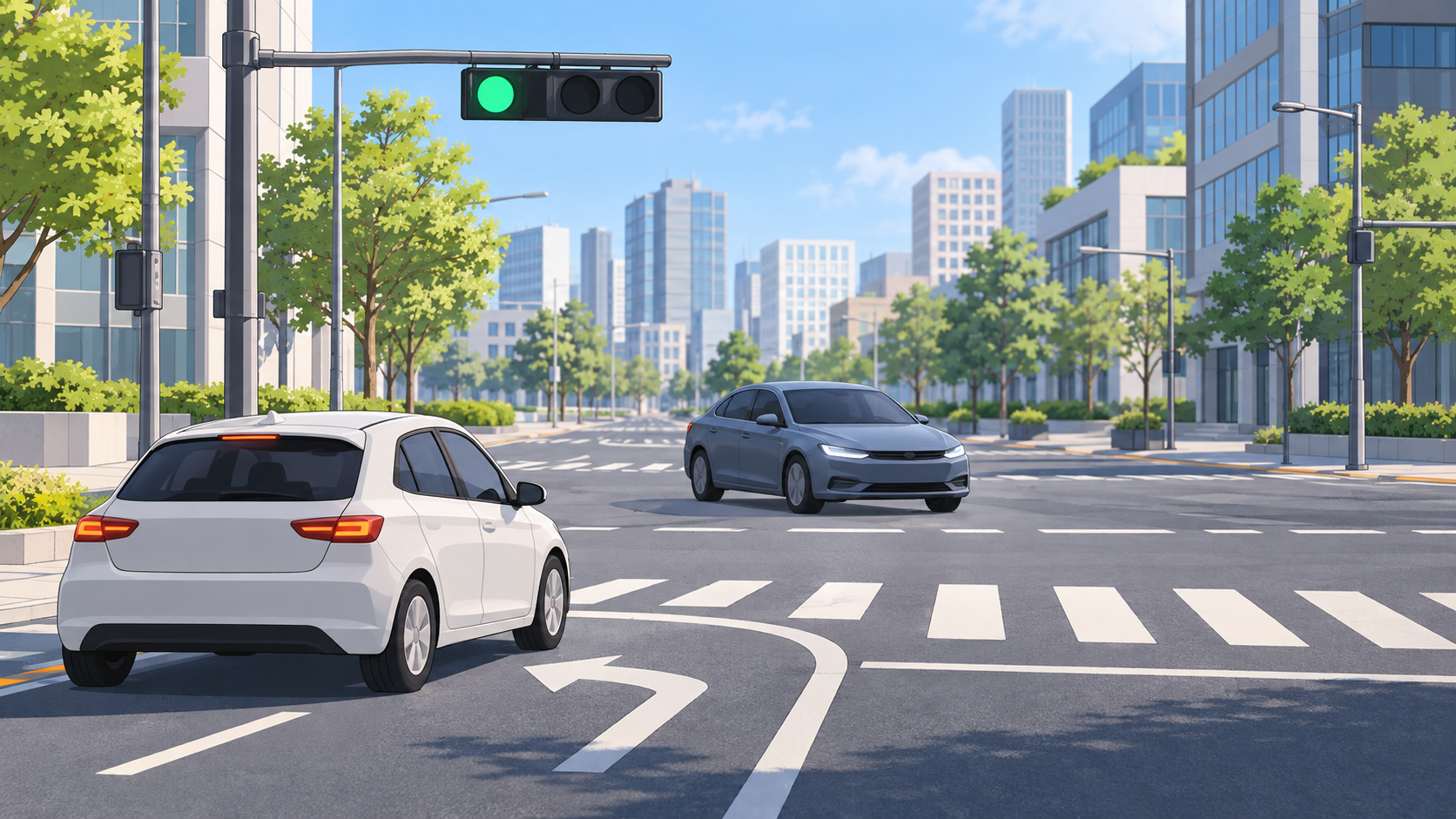
“Unprotected” can sound like permission to turn whenever you see a gap. In Korea, it isn’t. A biboho jwahoejeon (비보호 좌회전, “unprotected left turn”) is tied to the traffic signal: the official sign description says the turn may be made during a jinhaeng sinho (진행신호, “proceed signal”), and only when it doesn’t interfere with vehicles coming from the opposite direction.
That Korean wording is the useful part. “Unprotected” doesn’t mean “ignore the light.” The regulation keeps the turn inside the signal system, then adds a second condition: you still can’t interfere with oncoming traffic.
The green light is the permission
The Road Traffic Act Enforcement Rule says this in two separate places, which removes a lot of room for guesswork.
Appendix 6 defines the unprotected-left-turn sign. Its description says a driver may turn left carefully during the proceed signal as long as the turn doesn’t interfere with vehicles coming from the opposite direction.
Appendix 2 explains the circular green vehicle signal. It says vehicles may go straight or turn right, and that at a place with an unprotected-left-turn sign or road marking, they may also turn left.
The red rule points the other way. Under the same table, a circular red light requires vehicles to stop before the stop line, crosswalk, or intersection. The exception listed there is for right turns under specified conditions. It isn’t permission for an unprotected left turn.
So if you’re driving in Korea and see the sign, the order is straightforward: wait for the ordinary green signal, check the opposing lane, and turn only when you won’t interfere with oncoming traffic.
Why the Korean phrase can mislead in English
The term biboho (비보호) means “unprotected” or, more literally, “not protected.” That can sound broader in English than the rule actually is.
The key phrase in the regulation is jinhaeng sinho (진행신호, “proceed signal”). The sign’s legal meaning is written around that condition. In other words, the sign doesn’t create a free-standing right to turn whenever traffic looks clear.
This is a small translation detail, but it changes the driving decision. If you translate only the sign name, you might focus on the gap in opposing traffic. If you read the Korean rule, the sequence is two-step: first the proceed signal, then the safe gap.
The red light isn’t a shortcut
This matters because a red light can tempt a visitor to treat the maneuver like a permissive turn rule from somewhere else. Korea’s signal table doesn’t frame it that way.
Article 5 of the Road Traffic Act also requires road users to follow traffic-safety signals and directions. The unprotected-left-turn sign works together with the signal indication rather than replacing it.
There’s one more useful way to remember the distinction. The sign doesn’t promise that the opposing stream will stop for you. Its own definition says your turn must not interfere with those vehicles.
That makes a compact rule of thumb possible: green first, gap second. The green signal opens the possibility of the turn. The oncoming traffic decides whether that turn is actually clear enough to make.
Sources
- National Law Information Center: Road Traffic Act Enforcement Rule, Appendix 6. The “비보호 좌회전 표지” entry says the turn may be made during the proceed signal without interfering with oncoming vehicles. Checked 2026-09-24.
- National Law Information Center: Road Traffic Act Enforcement Rule, Appendix 2. The vehicle-signal table says green permits an unprotected left turn where the sign or marking is present; red requires a stop, with a right-turn exception. Checked 2026-09-24.
- National Law Information Center: Road Traffic Act, Article 5. Article 5 requires road users to follow traffic-safety signals and directions. Checked 2026-09-24.