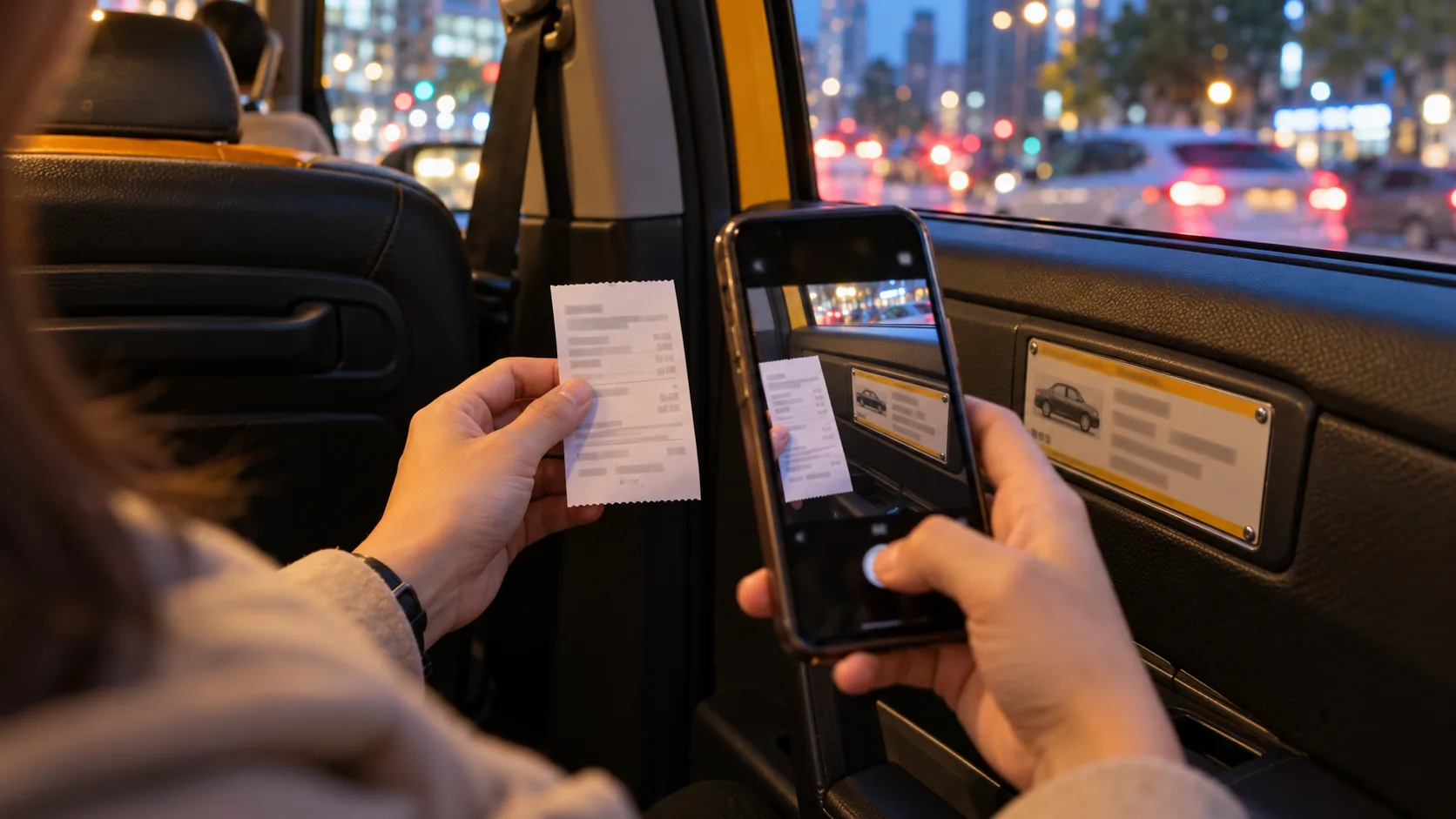
If a Seoul taxi fare looks wrong, keep the printed receipt before you leave. Since December 2025, Seoul says receipts produced through its work with Tmoney Mobility have added English for the final fare and pickup and drop-off times. They also show whether late-night or outside-Seoul surcharges were applied and point passengers to the 120 Dasan Call Center.
That is useful evidence, though it is not the whole case. Photograph the taxi’s vehicle number as well. Korea’s official Easy Law service says a taxi complaint should include the vehicle number, place, date and time, and a detailed account of the suspected violation.
Save the details while the car is still there
Ask for the paper receipt and take one clear photo of it. Take a separate photo of the vehicle number, either from the information displayed in the taxi or from the plate after you get out safely. Note your pickup and destination, the amount you paid, and what specifically seemed wrong.
The Easy Law taxi complaint guidance, current as of September 15, 2026, explicitly recommends photographing the vehicle number. A map-app estimate can help you remember what you expected, but it does not replace the meter record, the receipt, or the route details.
Use a factual description. “The receipt shows an outside-Seoul surcharge, but both pickup and destination were in Seoul” gives an investigator something to check. “The driver scammed me” does not identify the disputed charge.
What the receipt can settle, and what it cannot
Seoul’s January 21, 2026 service notice separates the clues across the printed receipt and several taxi apps.
| Clue | Where to look | What it helps you check |
|---|---|---|
| Final fare and trip times | Updated Tmoney Mobility receipt | The recorded amount and when the ride began and ended |
| Late-night surcharge | Receipt | Whether the meter marked the ride as subject to a late-night surcharge |
| Outside-Seoul surcharge | Receipt | Whether an outside-city surcharge was marked, not whether it was lawful for that exact route |
| Meter Fare and Toll fee | Supported taxi apps named by Seoul | Whether the app’s estimated driving fare and road toll were listed separately |
A surcharge flag does not prove misconduct. The official Seoul fare table, updated October 14, 2026, lists different rules by taxi type. For a standard medium taxi, late-night rates apply from 10 p.m. to 4 a.m., with the highest late-night band from 11 p.m. to 2 a.m. The standard outside-Seoul surcharge is 20 percent, but the same page says it is not applied between Seoul and Incheon Airport within the designated joint-service area.
That is why the route matters. Keep the flag, times, and locations together instead of deciding from one line on the receipt.
The app distinction matters too. Seoul says K.ride, TABA, TADA, and Onda were set to separate the estimated driving fare from a toll-road fee. A toll can be legitimate when a paid road was used. Record the route and the toll line rather than treating every amount above the meter estimate as a surcharge.
Use the QR sticker or call 120
Seoul placed taxi complaint QR notices inside taxis and at major tourist areas. If the sticker is available, scan it before leaving the scene or take a photo so you can open it immediately afterward. The city describes the QR form as a channel for foreign passengers to report taxi-use problems and suspected illegal conduct. There is no stable public QR destination on the city’s notice that can substitute for the physical code.
The other route is the 120 Dasan phone service. Its public page, checked October 21, 2026, requires no login and offers a language menu on the website. Korean phone counseling runs 24 hours a day. Foreign-language phone counseling runs on weekdays from 9 a.m. to 6 p.m.
From a Seoul landline, dial 120. From a mobile phone or outside Seoul, the listed numbers are 02-120 and 02-731-2120. From overseas, use +82-2-731-2120. Press 1 for a counselor. Ordinary call charges may apply.
Have this short record ready:
- taxi vehicle number
- pickup and destination
- date and exact trip times
- final amount paid
- surcharge or toll shown
- a concise account of what happened