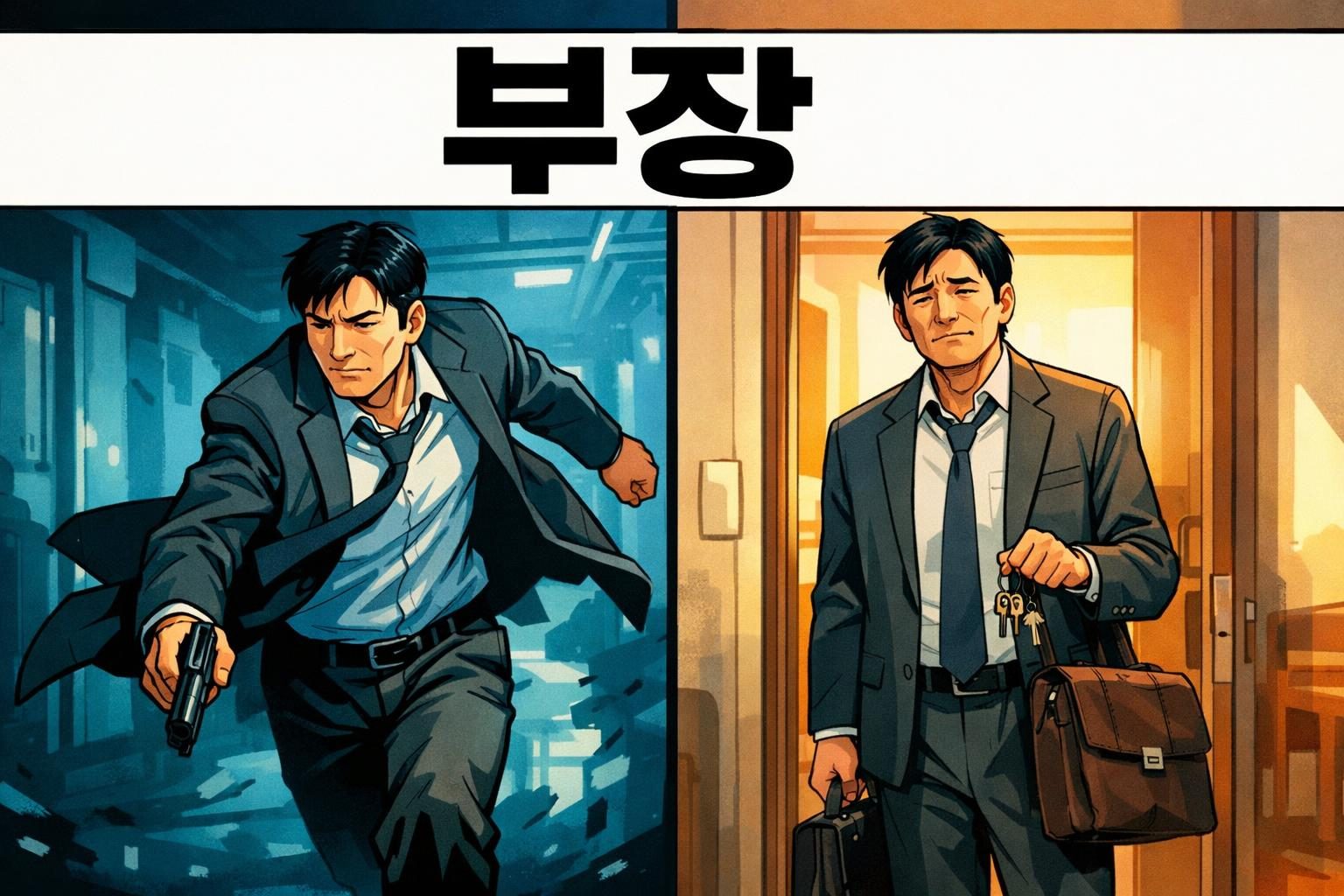
The character poster for SBS’s Kim Bujang shows So Ji-sub in glasses and a suit, next to a line that roughly means “Let’s not mess with the middle-aged guy in glasses.” The joke is that a bujang (부장, “department chief”) is the last person in a Korean office you’d expect to be dangerous, and I think the whole show runs on that.
It’s the second hit in a year named after the rank. JTBC’s The Dream Life of Mr. Kim aired in October and November 2025, and its Korean title reads “The Story of Bujang Kim, Who Owns His Home in Seoul and Works at a Big Company.” Neither show kept the word in English: the SBS one is Agent Kim Reactivated.
One rung below the executive cut
The usual ladder at a Korean company goes sawon, daeri, gwajang, chajang, bujang: staff, assistant manager, section chief, deputy department chief, department chief. Above that is imwon (임원, “executive”), and the step up is steep.
In November 2025, Seoul Shinmun ran a Korea CXO Institute analysis under a headline borrowed from the JTBC show: what are the odds that Bujang Kim at a big company becomes an executive? At Korea’s 100 largest listed companies, there was one executive for every 122.5 employees. That’s 0.82%, down from 0.84% the year before.
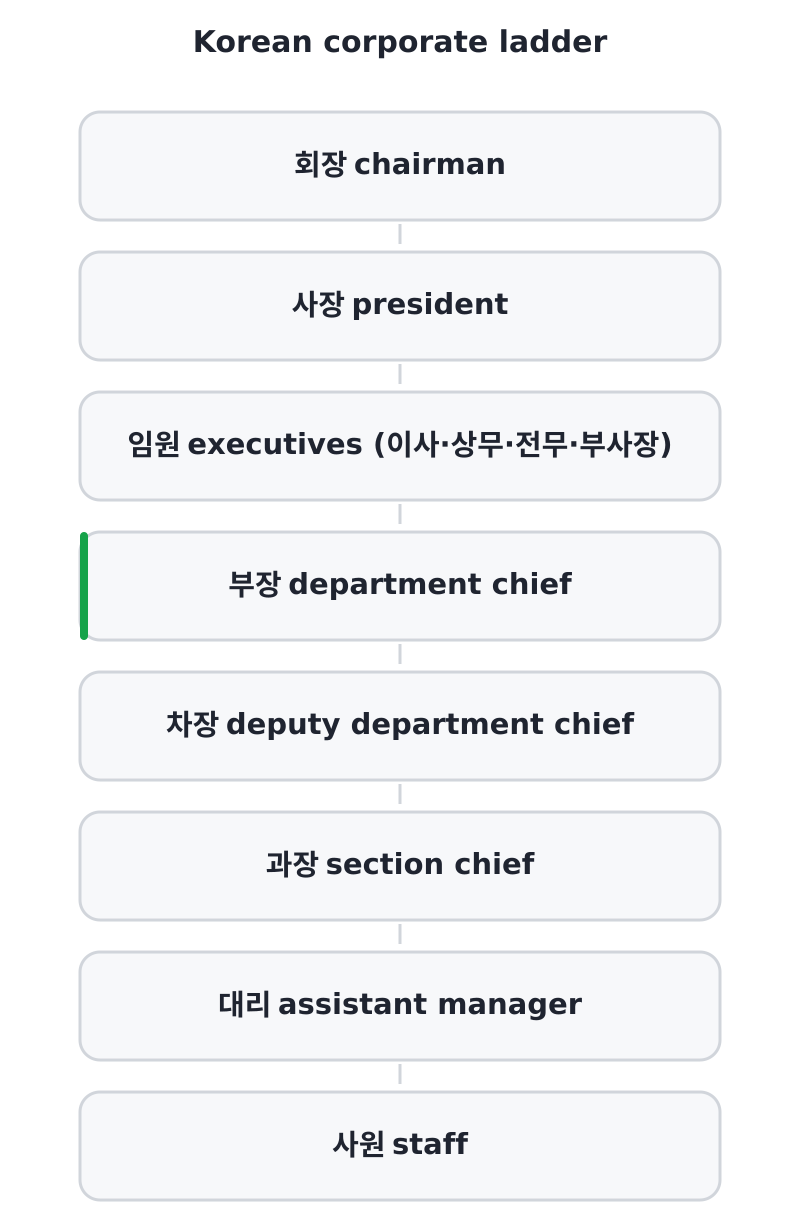
So a bujang is senior enough to run a department and still waiting on a decision made above him. Both dramas use that gap, from opposite ends.
Mr. Kim, with every box checked
Read the JTBC title as a list. Seoul, not the provinces. Jaga (자가, “self-owned home”), not a lease. A big company, not a small one. Bujang. When the author, Song Hee-gu, went on CBS radio, he called the title irony: a man who seems to have it all and is kind of hollow inside.
Kim Nak-soo has spent 25 years in a big company’s sales team to reach bujang, with only the executive promotion left. In the drama he calls his old Seoul apartment the trophy of his 51 years. Then he’s passed over, sent down to a regional factory, and told to cut roughly 20 jobs there. He quits instead. Harper’s Bazaar Korea wrote that among office workers, the show passed for horror.
The story started as a blog serial in 2021. Weekly Donga reports it passed 10 million views within a month, and Song told CBS it spread through KakaoTalk until publishers and production companies called. Ryu Seung-ryong, who played Kim, won the grand prize for television at the 62nd Baeksang Arts Awards in May 2026. In his speech he pointed out that Nak-soo means falling water. He’d thought falling was the end, he said, and it became a stream, then a river, then the sea.
Kim Bujang, with the rank as cover
The SBS version flips the same image. Kim is the accounting-team bujang at a small savings bank, raising his daughter alone. He’s also a former North Korean special operative, and when his daughter Minji goes missing, that past comes back out. The show is based on a Naver webtoon of the same name.
I think the cover works because nobody looks twice at a bujang from a savings bank. I’d bet most Korean viewers could sketch his outline before episode one: the suit, the glasses, the accounting team. The show asks what happens if that outline is the disguise.
It opened at 9.5% on June 26, 2026, and its July 25 finale drew 23.0% nationwide, with a minute-by-minute peak of 27.1%, per Nielsen Korea. In Gallup Korea’s July survey of favorite programs, 18.9% of respondents named it. That’s the highest share for any program since Gallup started the survey in January 2013.
So the version with a North Korean agent, not the one with the apartment and the factory, is the one that broke Gallup’s record. My guess is that watching a bujang win is more fun than watching one fall, and it’s only a guess.
Sources
- Seoul Shinmun, “대기업 다니는 김부장, 임원 될 확률은?” (November 2025)
- CBS NoCut News via Daum, interview with Song Hee-gu (November 28, 2025)
- Weekly Donga via Daum, “‘김 부장 이야기’ 송희구 작가가 200억대 자산 일군 비결” (December 14, 2025)
- Harper’s Bazaar Korea, “작가 송희구가 ‘김 부장 이야기’로 말하고 싶은 것”
- OSEN via Nate, Ryu Seung-ryong’s Baeksang grand prize speech (May 8, 2026)
- TV Report via Nate, “Kim Bujang” preview and character poster (June 20, 2026)
- bnt News via Daum, “Kim Bujang” character guide (June 26, 2026)
- News Edu, “Kim Bujang” finale ratings (July 2026)
- Newsin, Gallup Korea favorite programs for August 2026
- Wikipedia, “Agent Kim Reactivated”
- Wikipedia, “The Dream Life of Mr. Kim”