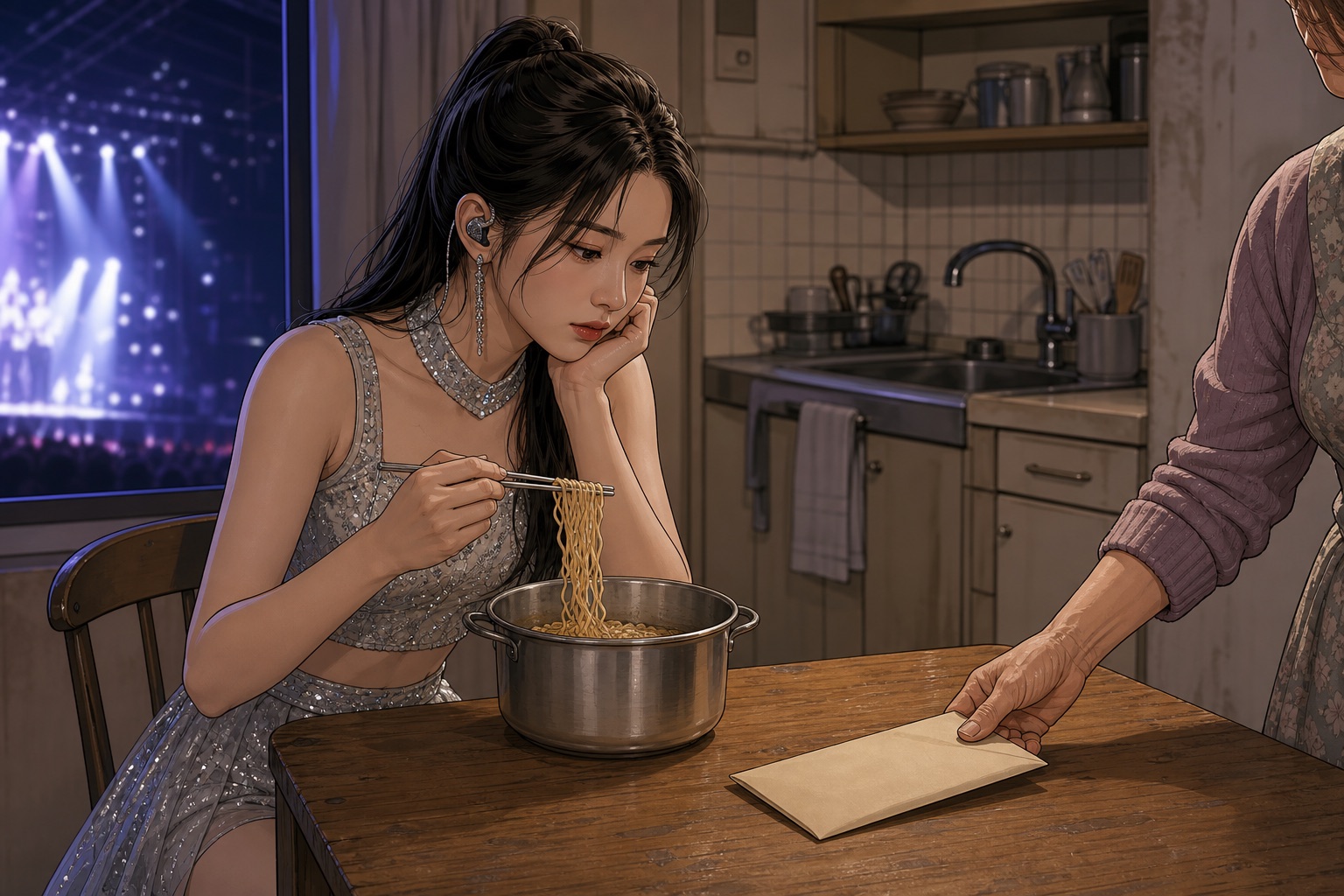
In a Workman episode posted June 17, 2026, Park Jiwon of fromis_9 spends a shift at a bank and asks the employee training her about salary. When the employee guesses an idol must earn several times more, she pushes back. Until a year or two ago she’d been flat broke, she says, with no income for eight years, and her settlement money had only started coming in recently.
She put it at almost seven years on JTBC’s Knowing Bros, in an episode that aired August 29, and said she’d lived on an allowance from her mother. fromis_9 debuted in January 2018.
Some of the Korean coverage leaned on the HYBE angle. Star News ran the Workman story under a headline about her having been at HYBE. The group only moved to Pledis, a HYBE label, in August 2021, and that contract ended on December 31, 2024. Her seven or eight years cover more than one company, and neither report has her blaming anyone. I’m not going to guess.
The word is jeongsan
Jeongsan (정산, “settling the accounts”) is the same word you’d use for splitting a dinner bill. In the industry it’s the payout an artist gets once the agency has done the math, and it’s what idols mean when they talk about years without one.
Bizhankook’s 2024 series on idol contracts described the order in one phrase: seon-gongje (선공제, “deducting first”). Whatever the agency has put in comes out before the remaining profit gets split with the artist. The lawyer Jeong Ji-seok told the paper that once an agency takes its investment back first, the deal stops being a real partnership.
What the standard contract lets come out first
The government’s standard contract for singers, in its June 2024 revision, spells out the pieces. Article 12 lets the agency deduct the direct costs of the singer’s official work from what that work earns, including vehicle upkeep, food, clothing, housing and transport, along with ad commissions and anything else spent with the singer’s consent.
Article 13 says training costs are the agency’s to pay in principle. It also says they can be passed to the singer with consent and taken out of future income.
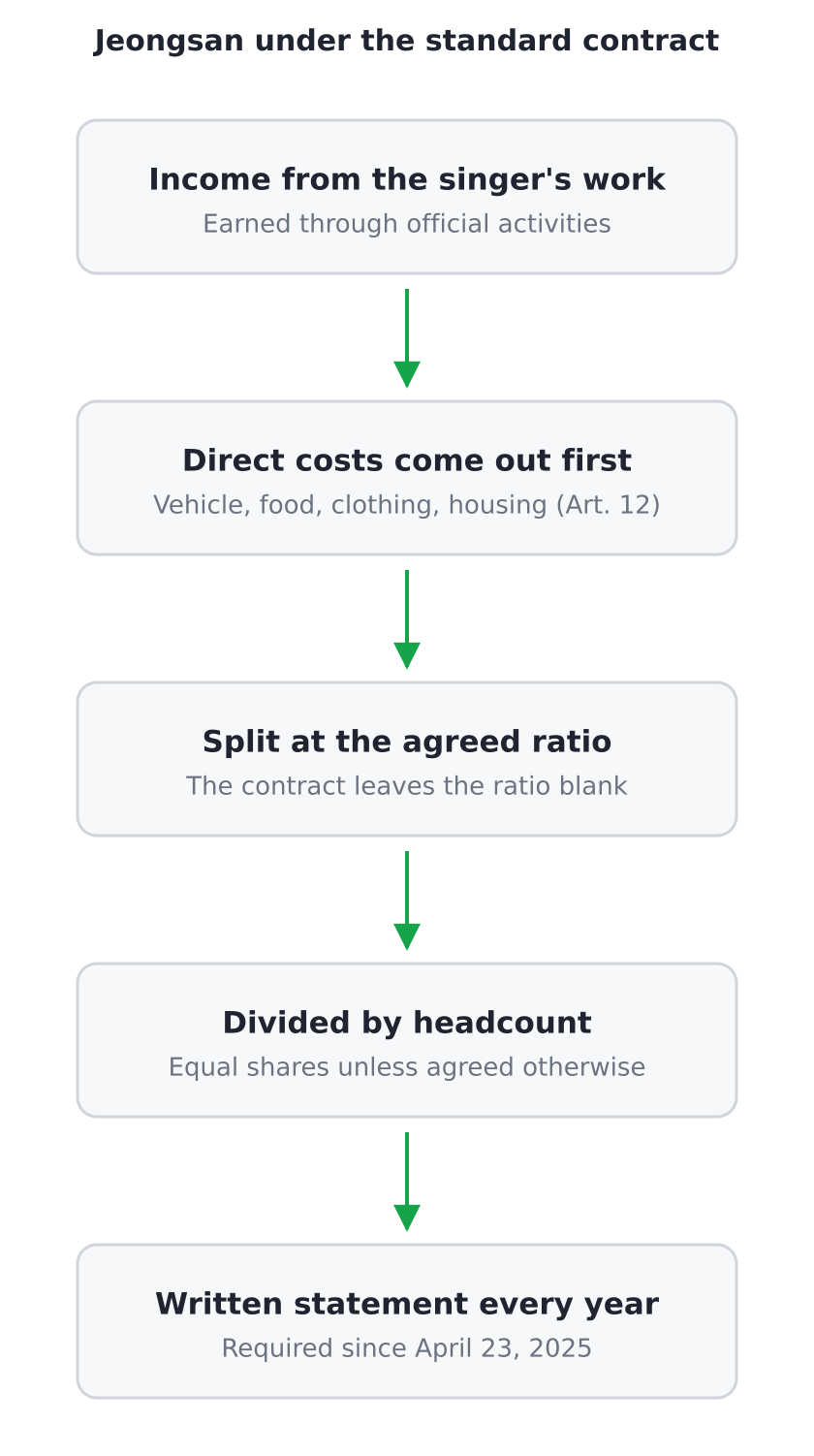
The ratio itself is left blank. Article 12 says the two sides agree on it separately, and for a group, the artist share is divided equally by headcount unless they agree otherwise. Bizhankook reported splits running anywhere from 9:1 to 6:4 in the agency’s favor, even after costs come out. When I see a split quoted anywhere, I keep that order in mind.
Two idols, no receipts
Neither of these is about fromis_9. Bizhankook didn’t name the groups.
The paper obtained the settlement statements of a well-known idol it called A, in a six-member group on a 50:50 deal. A’s real share of net profit ran between 5 and 16 percent, changing from statement to statement. A’s side said the statements were just amounts written in numbers on A4 paper, and they never saw a receipt.
Another idol, B, said seven years went by without a single settlement or a single settlement document. The contract was 7:3 for the first five years and 6:4 after that. When a member raised it, B said, the answer was roughly that if you had 1.6 billion won, you could pay it and leave.
What changed in April 2025
In September 2024 the National Assembly passed an amendment to the Popular Culture and Arts Industry Development Act, nicknamed the Lee Seung-gi law after the singer’s settlement dispute with his former agency. The enforcement decree that took effect on April 23, 2025 is specific.
At least once a year, even if the artist doesn’t ask, the agency has to hand over a document showing the accounting records tied to that artist, the money it received from third parties for the artist’s work, the pay the artist is owed, and when it’ll be paid.
Chosun Biz reported before the change that some agencies had only let artists look at the records without giving them copies. As I read it, the new rule is about disclosure. There’s nothing in that article of the decree that sets the ratio or limits what counts as a cost.
Sources
- Xportsnews via Daum: Park Jiwon on Workman, June 2026 (Korean)
- Star News: Park Jiwon’s settlement comments on Workman (Korean)
- Ilgan Sports: Park Jiwon on Knowing Bros, August 2026 (Korean)
- Ilgan Sports: Pledis statement on fromis_9’s contract ending, November 2024 (Korean)
- Bizhankook: what changed after the TVXQ case (Korean)
- Bizhankook: inside idol settlement statements (Korean)
- Ministry of Culture, Sports and Tourism: standard exclusive contract for singers, 2024 revision (Korean, PDF)
- Xportsnews: amendment passes the National Assembly, September 2024 (Korean)
- Chosun Biz via Daum: annual written settlement statements, March 2025 (Korean)
- Korea Law Information Center: Popular Culture and Arts Industry Development Act enforcement decree (Korean)