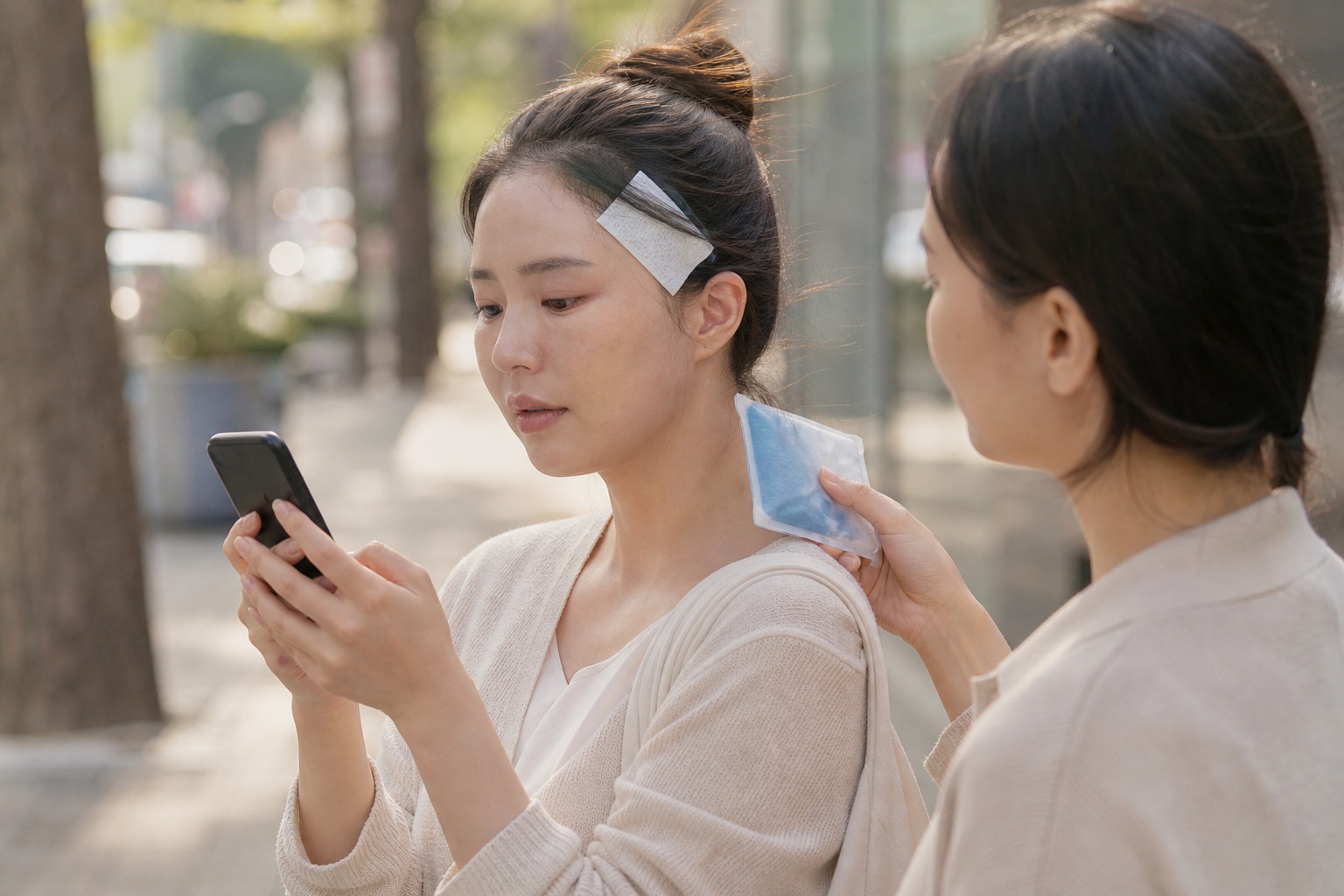
In late August 2026, Ruby Tuesday Matthews, a 33-year-old Australian influencer, posted about recovering from an endoscopic facelift she’d had in Seoul. The detail that got picked up, in Korea too, was her phone. She said she had to go to an Apple Store in her pajamas and reboot the whole thing, because there was no way it was recognizing her face.
The Daily Beast’s headline said the swelling made her “unrecognizable.” I’d call that a fair word for a headline. Matthews put it differently in one of her posts: “What you’re seeing now is swelling, not a new face.”
The word in the Korean report
Money Today picked up the story on August 29, citing news.com.au. It gave the cause in one word: Face ID didn’t work because her bugi (부기, “swelling”) was severe. The report also noted she’d said she wanted to look refreshed, not change her appearance, and that she planned to post a before-and-after once the bugi went down.
I think bugi is the more accurate word for what her phone ran into. The National Institute of Korean Language defines it as a medical term for the swollen state caused by edema, written 浮氣 in hanja, and the standard way to say it goes down is bugi-ga ppajida (부기가 빠지다, “the swelling drains out”). It’s a state you wait out, and the verb already assumes it’ll leave.
The institute has had to answer the spelling question more than once, too. People also write 붓기, and the institute says that isn’t the standard form. That one’s the noun form of the verb “to swell,” as in an ankle that’s starting to swell, so it doesn’t fit the medical sense. I’m a little delighted that a government language body has an official position on how to spell post-op swelling.
What the phone was built to do
Apple’s support page says Face ID adapts to changes like makeup or growing facial hair. For a more significant change, like shaving off a full beard, it confirms your identity with the passcode before it updates the face data. Matthews described her swelling getting much worse within a day or two of surgery, which isn’t the gradual kind of change the page describes.
Surgery is the smaller slice
She’s also part of a smaller group than the story might suggest. Korea’s Ministry of Health and Welfare counted 2.01 million foreign patients in 2025, the first year over two million since it began tracking in 2009, and Seoul took 87.2% of them. Most weren’t here for surgery.
Dermatology accounted for 62.9% of foreign patients. Plastic surgery was 11.2%, or about 233,000 people. Among American patients, plastic surgery came third at 9.3%, behind dermatology and internal medicine.
Sources
- Money Today, “한국서 성형수술한 외국인…’휴대폰 쓸 수가 없다’ 당황” (August 29, 2026)
- The Daily Beast, “Influencer Ruby Tuesday Matthews Says Post-Facelift Swelling Made Her Unrecognizable” (August 24, 2026)
- Mamamia, “Ruby got a facelift at 33. It was more graphic than she realised.” (August 28, 2026)
- National Institute of Korean Language, “부기가 빠지다” Q&A
- National Institute of Korean Language, “부기 붓기” Q&A
- Apple Support, “About Face ID advanced technology”
- Ministry of Health and Welfare, 2025 foreign patient figures (April 2026)