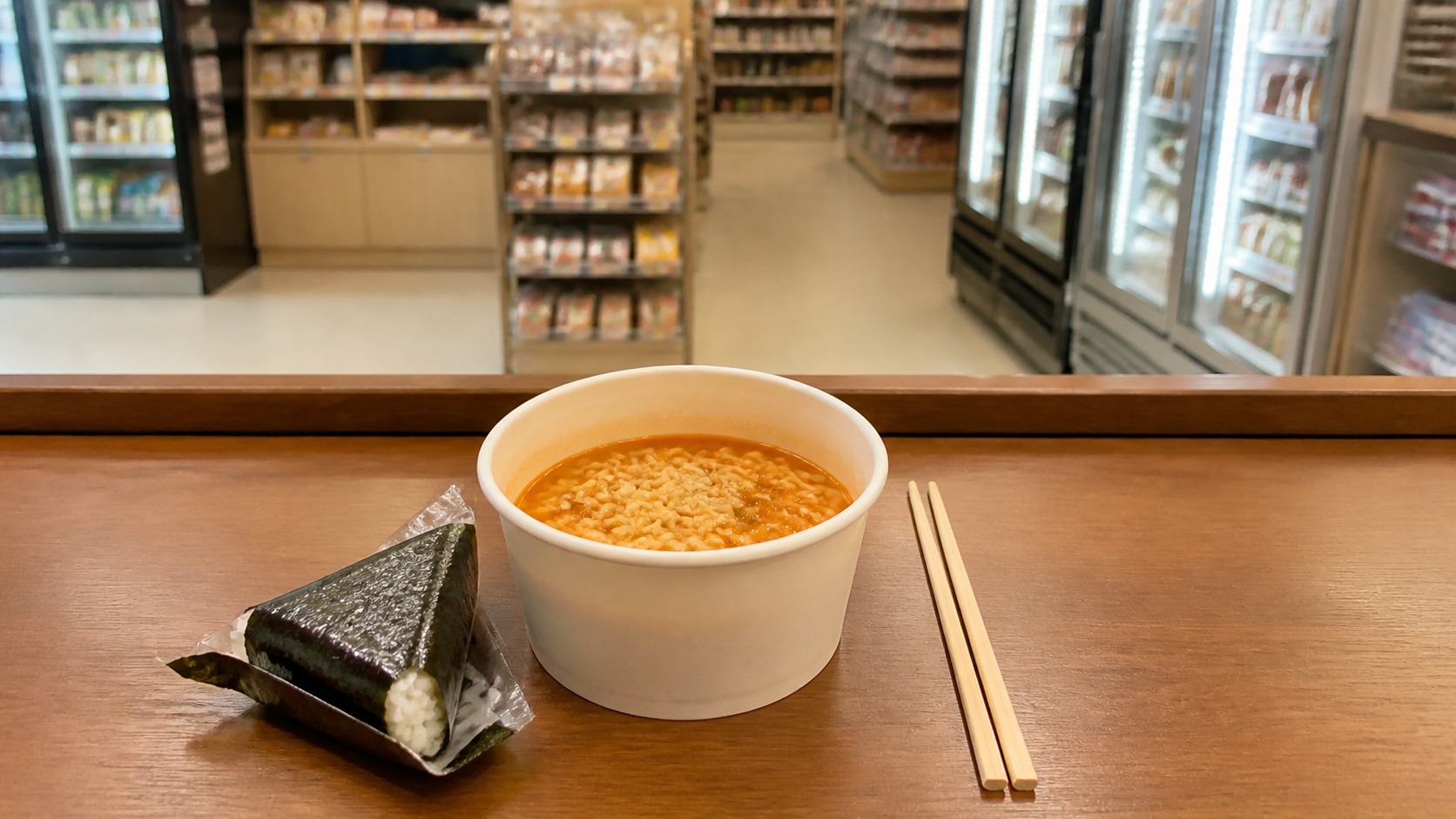
Whether you could open a samgak gimbap (삼각김밥, “triangle gimbap”) without wrecking it used to be one more way to tell younger Koreans from older ones. A trade paper covering Korea’s food industry said so in 2003, almost in passing.
I love that line, honestly, because it means the wrapper beat Koreans too. A rice triangle next to a bowl of ramyeon looks like the most settled late dinner in the country. It’s newer than it looks, and each part of it came with something people had to learn.
A 1990s import that needed a price cut
The rice triangle showed up in the early 1990s, adapted from Japanese onigiri, and it didn’t catch on right away. The boom started in 2000, when mass production let the price fall from 900 won to 700 won. A TV ad in 2001 pushed it further, and during the 2002 World Cup, stores near the street-cheering crowds sold 1,500 to 1,800 triangles each.
The top seller at the big chains back then wasn’t tuna mayo. It was a Jeonju bibimbap version with the filling mixed through the rice. Tuna mayo was already one of the hits, though, and if your noodles are spicy it’s still the one I’d tell you to get.
The opening method in that 2003 article is basically the one people still use. You tear the strip down the middle first, then pull each half of the plastic out sideways. The film keeps the seaweed away from the damp rice until the last second, so if you rip it open like a sandwich bag, the seaweed stays behind in the plastic. Most readers, the article guessed, would remember being stumped the first time.
The pairing with noodles was already there too. That same year 7-Eleven was running promotions that threw in a drink or a cup ramyeon as deom (덤, “a little extra, on the house”). It makes sense to me. At home the last of the ramyeon soup gets rice dumped into it, and a rice triangle is that rice with a filling, already sitting in the store.
I think the one real mistake is dropping the whole triangle into the bowl. The rice swells, the seaweed goes limp, and you’ve got a soggy mess to finish. A bite of rice, then noodles, works better, or tear off a corner and dip just the edge.
The machine that got its own name
The newest thing to learn is the cooker. Hangang ramyeon (한강라면, “Han River ramyeon”) is what people call a packet of ramyeon boiled in one of those in-store machines. The name comes from the convenience stores in the Han River parks, where it caught on first. You open the packet, put the noodles and the soup powder into the store’s container, and press a button. The machine handles the water and the heat.
It’s spread fast. CU says its machine-cooked ramyeon sales grew 78% in 2024 and 88% in 2025, and it runs cookers in about 1,000 stores. That’s one chain’s count, so I wouldn’t expect one at every corner store.
Like the wrapper, it comes with instructions. A Seoul Shinmun column this August described the notices taped all around one of these machines: put the soup powder in with the noodles from the start, and don’t add the egg at the start, because it’ll stick to the bottom and burn. I find it kind of funny that a machine built to make ramyeon foolproof still needs a wall of warnings.
This year CU started putting tteokbokki through the same cooker. It sold 30,000 in its first month.
Sources
- Sikpum Eumryo Sinmun: How Korea’s rice triangle started, and its market (Korean, 2003)
- Seoul Economic Daily: Hangang ramyeon cooker export deal, with the origin of the name (Korean, 2024)
- Newspim: CU expands from Hangang ramyeon to instant tteokbokki (Korean, 2026)
- Seoul Shinmun: The Hangang ramyeon cooker (Korean column, 2026)
- Korea Tourism Organization: Taste the Soul Foods of Korea