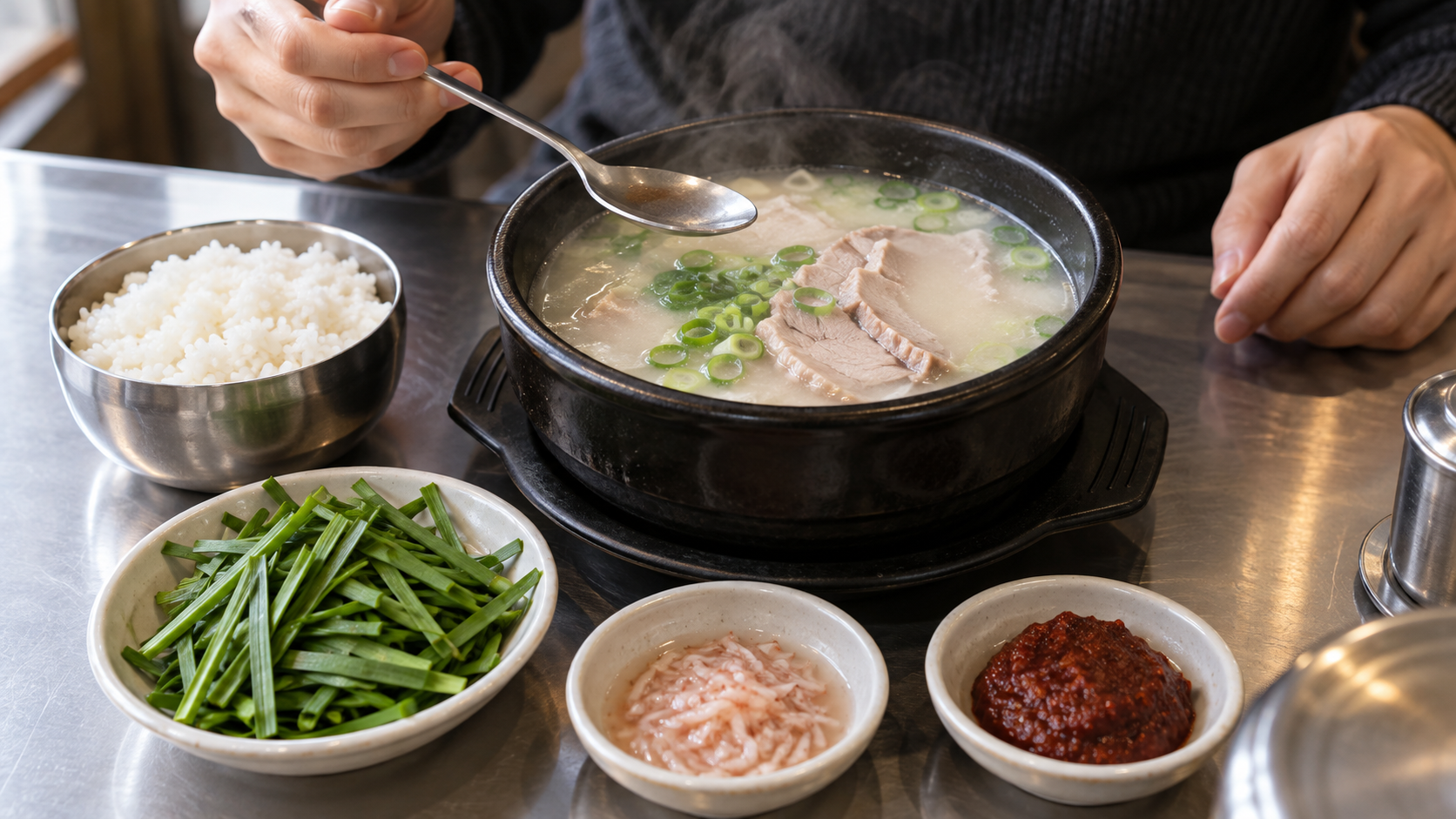
Busan’s city government keeps an essay on dwaeji gukbap (돼지국밥, “pork rice soup”) on its Future Heritage site, and tucked into it is a local joke: season the broth with salt and you’re not from Busan. The expected move is saeujeot (새우젓, “salted shrimp”), the small dish of fermented shrimp that comes with the bowl.
The joke only works because the soup shows up unfinished. The kitchen makes the broth and the pork, and a lot of the final seasoning is left to whoever’s eating. Honestly, that’s the part I like most about this dish.
A 2019 Busan Ilbo series that went through 30 pork-soup restaurants put it bluntly: once you count the side dishes and the ways of eating it, there are about as many versions as there are people at the table.
Taste first, then go slow with the shrimp
The usual order is simple. Chives go in first, then you taste the broth, then you adjust with the red seasoning, salted shrimp, or salt. If it were me, I’d add the saeujeot a few shrimp at a time from the tiny spoon. It’s salt with a fermented edge, and once it’s in, you can’t get it back out.
The chives are the one thing you can be generous with. In Busan they’re jeongguji (정구지, “chives”), the local dialect word, and the city’s essay says the standard Korean word just doesn’t taste right to people there. The usual side dish is chives dressed with chili flakes, though some of those 30 shops served chive kimchi or plain raw chives instead.
The red spoonful has a borrowed name
The red paste is dadaegi (다대기, “minced seasoning”). Across those 30 shops it was usually chili powder mixed with scallion, garlic, onion, and soy sauce or fish brine, with each shop leaning on something of its own, like doenjang at one place and ground onion or garlic at others.
The word itself has a small history. The National Institute of Korean Language says dadaegi comes from the Japanese tataki, files it under Japanese-influenced food vocabulary, and recommends a plain Korean phrase for “minced seasoning” instead. Busan’s own heritage essay still says dadaegi, so I wouldn’t worry about which one you use at the table.
What matters more is how much goes in. Ten of the 30 restaurants set the seasoning out for you to add yourself. Where it arrives already sitting on the soup, you can usually lift some off before you stir. I’d do exactly that until you know the shop, because a full spoon turns a clean pork broth into a much louder one.
Rice and noodles on the side
Rice may come in the bowl or next to it. Of those 30 places, 17 offered both, and 12 served rice only on the side. My advice is to add side rice a spoonful at a time. The early bites stay brothy, the end of the bowl gets thick, and you don’t have to commit at the start.
Ten of them also put out thin wheat noodles, and those are older than they look. During the government’s campaign to cut rice consumption in the 1960s and ’70s, restaurants had to mix at least 25 percent barley or noodles into what they sold. The National Archives of Korea dates the noodles in beef soups to that rule, and the Busan series traces the noodles at gukbap shops to the same campaign.
Even the chives aren’t fixed. Back in 2019, Mina Sikdang in Jungang-dong was putting banga leaves, a Korean mint, or crown daisy in the bowl instead, depending on the season.
Sources
- VISITKOREA: Dwaejigukbap, Busan’s representative local dish
- Busan Future Heritage: dwaeji gukbap essay (Korean)
- Busan Ilbo, Busan Dwaeji Gukbap Road: no two bowls are the same (Korean, 2019)
- National Institute of Korean Language: spelling and origin of dadaegi (Korean)
- National Archives of Korea: the mixed-grain and flour food campaign (Korean)