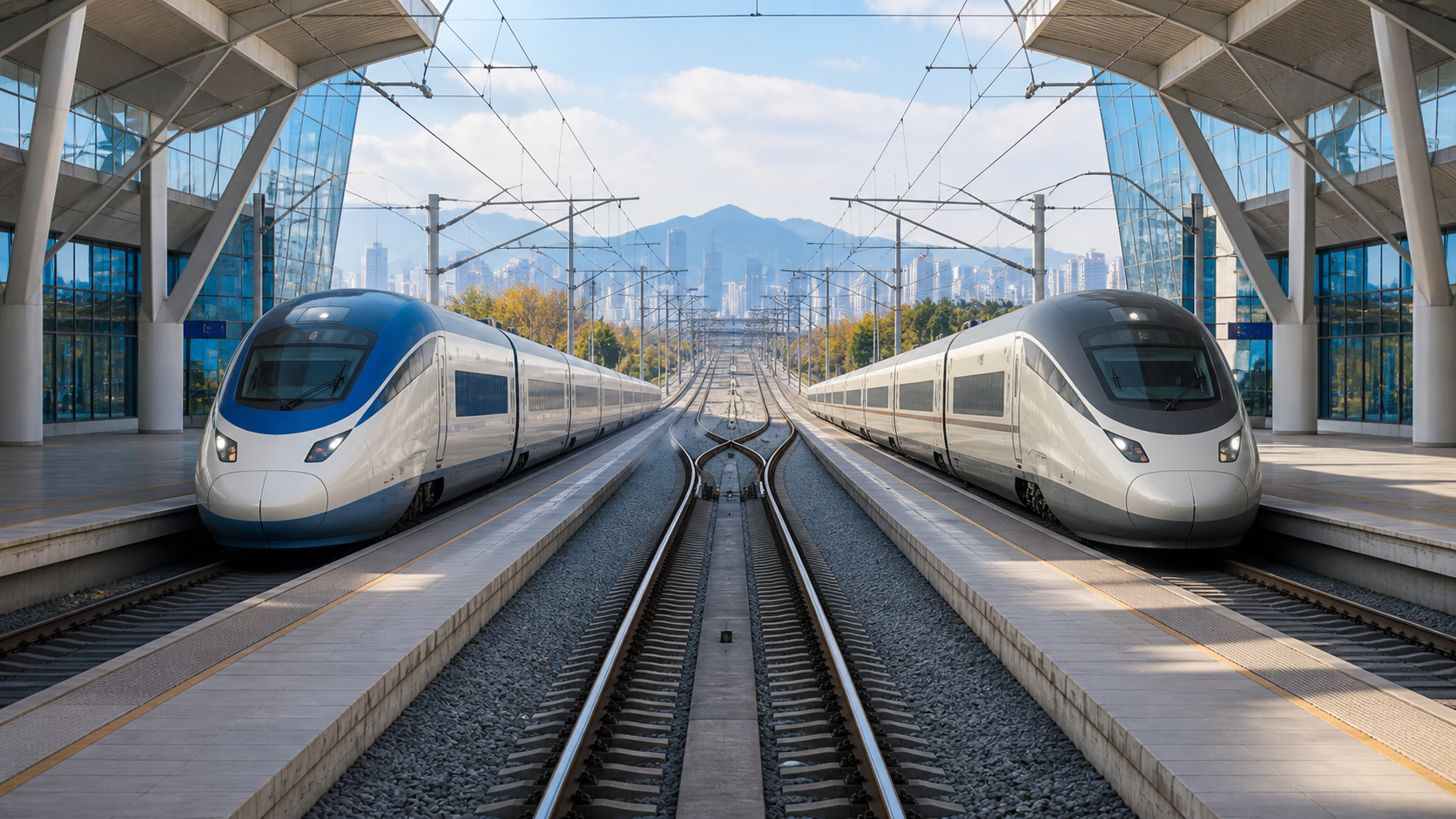
Korail’s first holiday ticket sale since absorbing SRT still gave Suseo its own day. For Chuseok 2026, KTX trains to and from Suseo went on sale on September 10. Seoul Station’s trains on the Gyeongbu Line to Busan got their own day, September 11.
That’s the part of the merger I think gets lost in the headlines. The SRT name and the SRT app are gone. The two Seoul terminals aren’t, and neither is the reason you’d pick one over the other. Here’s what changed for someone booking a high-speed train as of September 17, 2026, and what didn’t.
What actually merged on September 1
SR, the company that ran SRT out of Suseo Station since the Suseo line opened on December 9, 2016, was folded into Korail. The Fair Trade Commission approved the deal on August 2. SRT trainsets now run under the name KTX-Sancheon, and SR’s own app and website were only kept running through August 31.
Booking now happens in the Korail+ app, on Korail’s website, or at a station counter, and Naver and Kakao T sell the same trains. Korail members were moved to the new membership automatically. Anyone with an SR account had to convert it separately.
The day-to-day change is one search instead of two. Koreans call booking ahead yemae (예매, “buying in advance”), and for years a careful yemae on a busy weekend meant opening two apps and comparing.
Cheaper fares, with a date attached
Fares on the old KTX side dropped to the SRT level, about 10% lower on average. Korail’s own example is Seoul to Busan, which went from 59,800 won to 54,400 won. Suseo trips now earn 5% of what you pay as mileage, and former SRT routes got a looser change rule: free changes up to 30 minutes before departure, where SRT tickets used to allow changes only until three hours before.
The government says the merger adds about 15,000 seats a day on weekdays and up to 17,000 on weekends, with Suseo routes getting roughly 30% more. Suseo also gets Korail’s highest-capacity KTX sets, 955 seats per train.
The fare cut is where Korean coverage got skeptical. The 10% reduction was part of a three-year plan Korail submitted for the merger review, and the transport ministry and the Fair Trade Commission agreed to monitor fares and seat supply together for three years. In August, Maeil Shinmun reported that an internal Korail financial projection assumed the discount would end and fares would return to current levels after September 2029.
The ministry’s answer was that the projection was Korail’s own, not a government fare plan, and that fares after the discount period would be reviewed. I’d treat the lower price as a 2026-to-2029 price and not assume anything past that.
The station is still your decision
Nothing moved on the map. Seoul Station and Yongsan are in central Seoul, and Suseo is in Gangnam-gu, in the city’s southeast. Korean reporting on the merger still talks about suseobal (수서발, “departing Suseo”) high-speed trains, and the Chuseok sale shows that’s more than a label.
So the choice is the same one Seoul residents always made, just inside one app now. If I were staying around Jamsil or Gangnam, I’d look at Suseo first. From Myeong-dong or Hongdae, Seoul Station is the obvious start. A cross-town transfer can easily cost more time than picking a slightly later train from the closer terminal.
More seats also didn’t make the holiday easy. Korail said 1.8 million of its 2.14 million Chuseok seats were booked, 84%, with KTX alone at 92.7%. That’s well above the roughly 60% holiday booking rate of the previous three years, which Railway Economy put down to a shorter holiday this year.
What I can’t tell you is what a Seoul to Busan ticket will cost in October 2029. Nobody has announced it, and so far the ministry’s only answer is that it’ll be reviewed.
Sources
- 대한민국 정책브리핑, 내달 1일부터 KTX·SRT 통합 운행…요금↓·좌석 수↑ (2026-08-31)
- SR, 고속철도 통합에 따른 SRT앱·홈페이지 운영 알림 (2026-08-21)
- 철도경제신문, 9월부터 고속鐵 통합 운영 돌입…SRT는 ‘KTX-산천’으로 이름 변경 (2026-08-05)
- 한국경제, 코레일·SR 통합 승인…고속철도 ’13년 경쟁체제’ 막 내린다 (2026-08-02)
- 매일신문, 통합 고속철 할인 ‘반짝 3년’…이후 요금 도로 오른다? (2026-08-07)
- 금강일보, 2026 추석 기차표 예매 일정 (2026-09-07)
- 철도경제신문, 추석 승차권 180만매 판매, 예매율 84% 기록 (2026-09-14)
- 국토교통부, 2016.12.9, 드디어 「수서고속철도」가 개통됩니다 (2016-11-20)