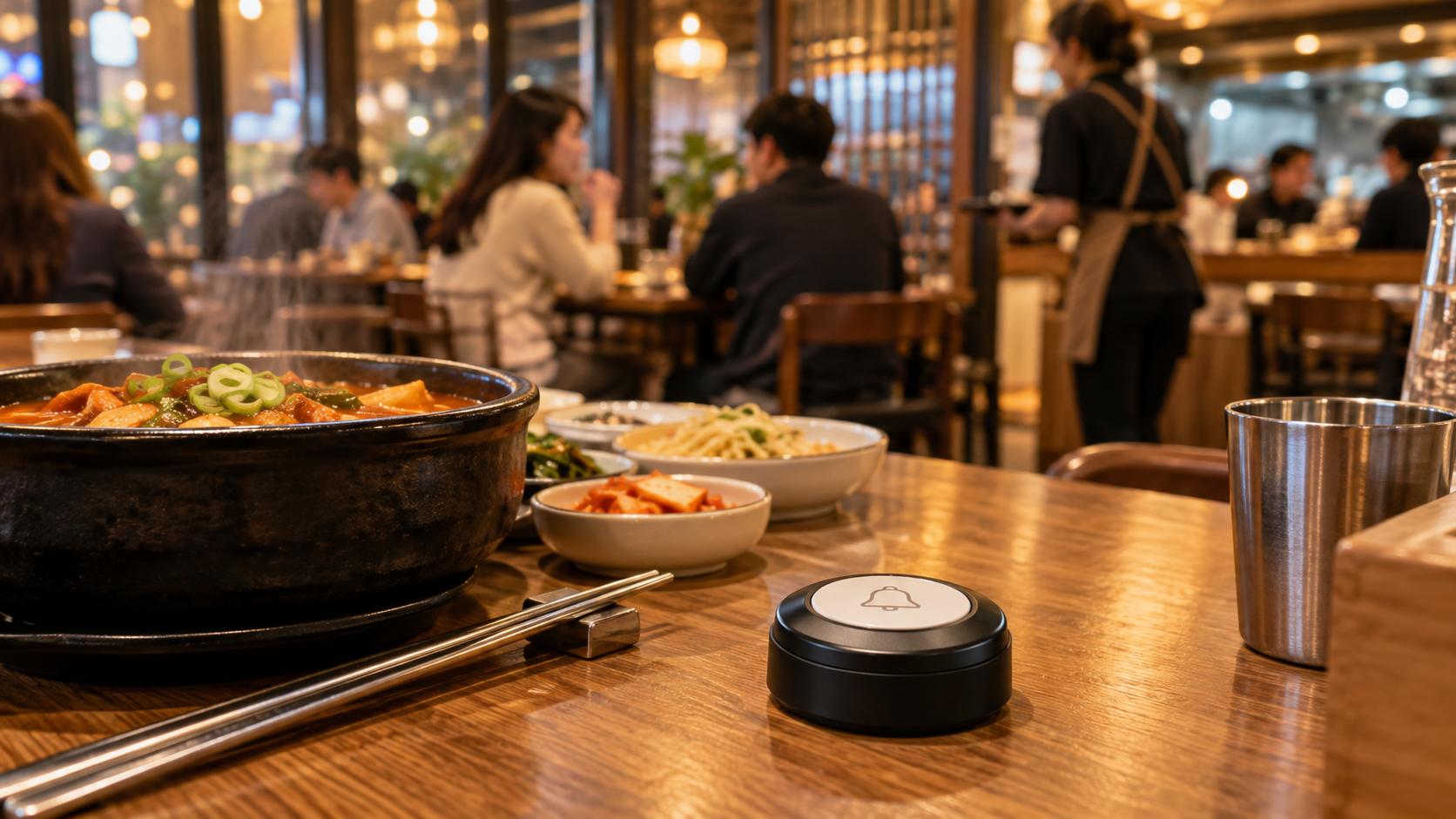
If ringing a bell for a person feels rude to you, I get why. From the outside it looks like summoning staff. In a Korean restaurant it works the other way around. There’s no comfortable word for calling the person who works there, and the button lets everybody skip the word.
Every word for a server is a compromise
The most common is jeogiyo (저기요, “over there”), which does the job of “excuse me.” Some borrow family words, like imo (이모, “aunt”) or even “mother” or “big sister,” for the person bringing the side dishes. Sajangnim (사장님, “boss”) comes up a lot too.
None of these is quite neutral, and there are numbers on it. In a 2017 National Institute of Korean Language survey of 4,000 people, reported by Edaily, 62.5 percent said they call a stranger jeogiyo.
When public-office, service, and sales workers were asked how they felt about what customers call them, 46.6 percent disliked the everyday words for “mister” and “ma’am.” Even jeogiyo and its cousin “over here” bothered 33.9 percent. That was the lowest of the options, and it’s still a third.
A National Institute of Korean Language official’s suggestion in that same article was to call restaurant staff sajangnim, or the word for “employee” with the honorific -nim, whatever their position or gender. So if a drama taught you to say sajangnim, you’re fine. I find the family words kind of warm, and I still wouldn’t start with them as a visitor. Jeogiyo is the safe one.
The bell skips the whole problem
That’s why I think the button is honestly the politest thing on the table. It tells staff which table needs them, and nobody has to pick a word. Use it to order, or for more side dishes or water.
Press it once and wait. Pressing again won’t bring anyone faster when the room’s busy. It just adds a soundtrack to everyone else’s dinner.
No bell? Raise a hand a little and say jeogiyo. And when you’re done, the bill usually gets paid at the counter on the way out rather than at the table.
Tablets are coming for the bell, slowly
In February 2024, the Korean business magazine Economist ran a headline announcing that “jeogiyo” had disappeared from restaurants, pushed out by tablet and QR-code ordering. The piece put it down to labor costs. It said the leading tablet-order company, founded in 2019, had passed 100,000 installed units in about four years.
The data moves slower than that headline. A Korea Rural Economic Institute report released in April 2024 put self-order machines in 7.8 percent of restaurants in 2023, up from 0.9 percent in 2018. At Korean-food restaurants the figure was 4.4 percent, and at bars it was 1.0 percent. So at most Korean-food restaurants in 2023, a person was still taking the order.
Korean-food restaurants were one of the fastest-growing categories in that report, though, with machine use growing at an average of 72.2 percent a year.
Sources
- Edaily: what to call restaurant staff, with National Institute of Korean Language survey figures (Korean, 2018)
- Economist (Korea): “Jeogiyo” disappears as tablet and QR ordering spread (Korean, 2024)
- KPN News: Korea Rural Economic Institute report on restaurant self-order machines (Korean, 2024)
- Official Jeju Tourism Guidebook
- Stripes Korea: dining out at restaurants