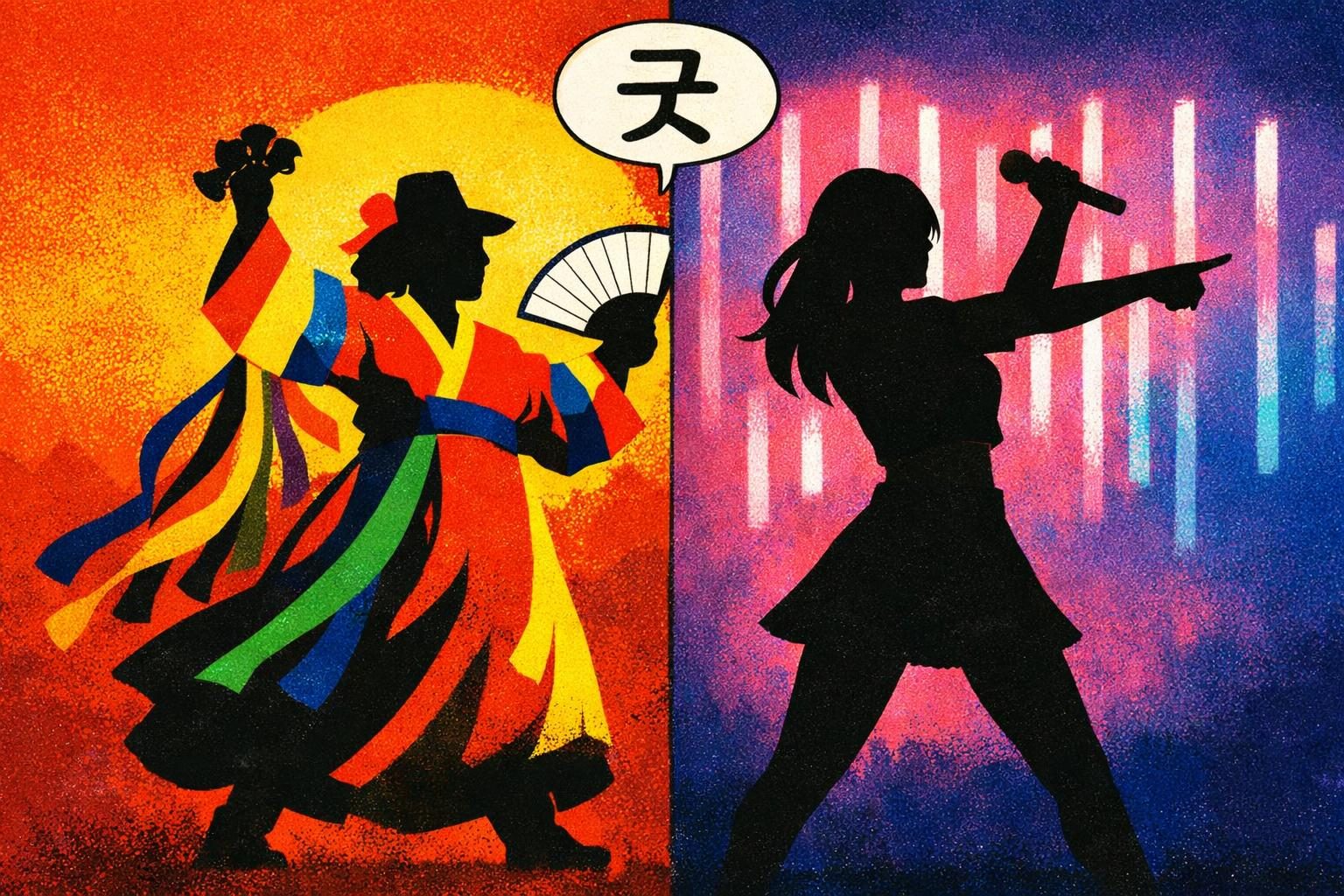
Look up gut (굿) in the Standard Korean Language Dictionary and the shaman ritual only comes second. The first meaning is a noisy, exciting spectacle that a crowd gathers to watch. Sense two is the ritual, where a shaman sets out food, sings and dances, and asks the spirits to sort out people’s fortunes.
I think that order honestly does half the explaining for KPop Demon Hunters.
The director’s word for it was concert
In a June 2025 interview with Newsis, co-director Maggie Kang said a gut is about driving off demons with music and dance, which fit the film’s concept, and that it already existed in Korean culture. She also said Korea’s mudang (무당, “shaman”) are almost all women, so that part connected well too. And she said that, in a way, she wondered whether gut was “the first concert.”
The dictionary’s on her side about the women part, for what it’s worth. Its entry for mudang says the word mostly refers to women.
Newsis described the heroes, HUNTR/X, as modeled on mudang and the rival Saja Boys on grim reapers. Netflix said in March 2026 that the film had passed 500 million views since its June 2025 debut and called it the most popular Netflix film of all time.
A gut runs in three moves
The Encyclopedia of Korean Culture, run by the Academy of Korean Studies, describes every gut with the same shape. The shaman invites a god, hosts it, and sends it off. A full gut is made of 12 to 30 smaller segments called geori (거리, “segment”), and each one repeats those three steps inside itself.
During the ritual the shaman wears clothes that stand for the god’s own, sings, dances, and speaks the god’s words out loud.
Shamans who came to the job through possession, mostly in central and northern Korea, work with a lot of wardrobe. The encyclopedia says they usually have 12 to 20 kinds of costume, each tied to the gods of a particular segment, and that their music leans on fast percussion. Hereditary shamans in the south don’t need nearly as many, usually two or three.
A gut and a K-pop show are different things, obviously. But a program of segments with a costume for each, over fast drums, is kind of hard not to compare.
The calling comes before the job
That kind of shaman starts with sinnaerim (신내림, “the spirit coming down”). The dictionary defines it as a spirit taking hold of someone fated to become a mudang. The encyclopedia describes the illness that comes first as lasting eight years on average, sometimes thirty, and says it’s believed to lift only after an initiation gut.
After that comes roughly three years of following the shaman who performed it, who becomes the new shaman’s spirit mother. I’d call the apprenticeship the more striking part. It’s the least cinematic thing on the list.
Entertainment is written into the job
The encyclopedia lists four functions for mudang: leading rites, healing, prophecy, and entertainment. It explains that the singing, dancing and leaping read to onlookers as a kind of show, and that the segments meant to please the gods turned into the most entertaining part for the people watching.
It even cites an old account of the character 巫, the one for shaman, as drawn from two people dancing on either side of 工. That’s the detail I’d point to if someone told me the concert idea’s a stretch.
The same entry ends somewhere less glamorous. It says shamanism is now widely treated as superstition, and mudang mostly work out of public view.
Sources
- Standard Korean Language Dictionary: 굿 (Korean)
- Standard Korean Language Dictionary: 무당 (Korean)
- Standard Korean Language Dictionary: 신내림 (Korean)
- Newsis: Maggie Kang interview, June 2025 (Korean)
- Netflix Tudum: KPop Demon Hunters sequel confirmed, March 2026
- Encyclopedia of Korean Culture: 굿 (Korean)
- Encyclopedia of Korean Culture: 무당 (Korean)