
English speakers hear “comeback” and picture someone returning after years away. The Standard Korean Language Dictionary is on their side. It defines keombaek (컴백) as returning to the stage you used to be active on.
K-pop uses the word for groups that haven’t gone anywhere. On September 17, 2026, Star News ran the headline that PLAVE would make a comeback on October 12.
What PLAVE had actually posted was a promotion schedule: concept films and images, a visual sampler, the tracklist, an album preview, a highlight medley, and music video teasers, all dated in advance. Digital release at 6 p.m. on the 12th, the physical album the next day, and preorders from the 17th in three versions.
I think “comeback” is closer to “the promotion window opens.” It’s a date on a schedule, and in PLAVE’s case that schedule went public 25 days before release.
A real return built the machinery
The history here caught me off guard. According to a 2019 SportsQ feature, the broadcaster pre-recording system goes back to 2000, when Seo Taiji came back after retiring in 1996. He asked to record his stage in advance, and MBC agreed.
Fans call it sanok (사녹), short for sajeon nokhwa, “pre-recording.” Hankook Ilbo explained in 2018 that music shows give acts with new albums pre-recorded slots for one to three songs, and that tapings get pushed into the early morning so they’re done before the live broadcast.
It also described how entry worked. Fans were sorted into roughly six tiers, and the top tier had to bring a fan club card, the latest album, and proof of buying the title track. I think that tier list explains the word better than the dictionary does. The fans in the top tier had already paid into the comeback before they’d seen a second of the stage.
The release hour tells you which chart
Newsen ran a piece in late August 2026 about the hour albums come out. Its starting point was that Monday at 6 p.m. had long been the accepted K-pop default. Red Velvet’s August 3 release kept to it. Stray Kids on August 7 and ENHYPEN on August 21 released on Fridays at 1 p.m. instead.
Newsen’s explanation isn’t complicated. Six in the evening catches Korean listeners on the way home and pushes first-day domestic chart numbers, and since music show rankings are counted by the week, an early-week release helps there too.
One in the afternoon in Seoul is midnight on the US East Coast in summer. The Friday matters because Billboard’s tracking week runs Friday to Thursday, so a Friday release gets all seven days in its first week.
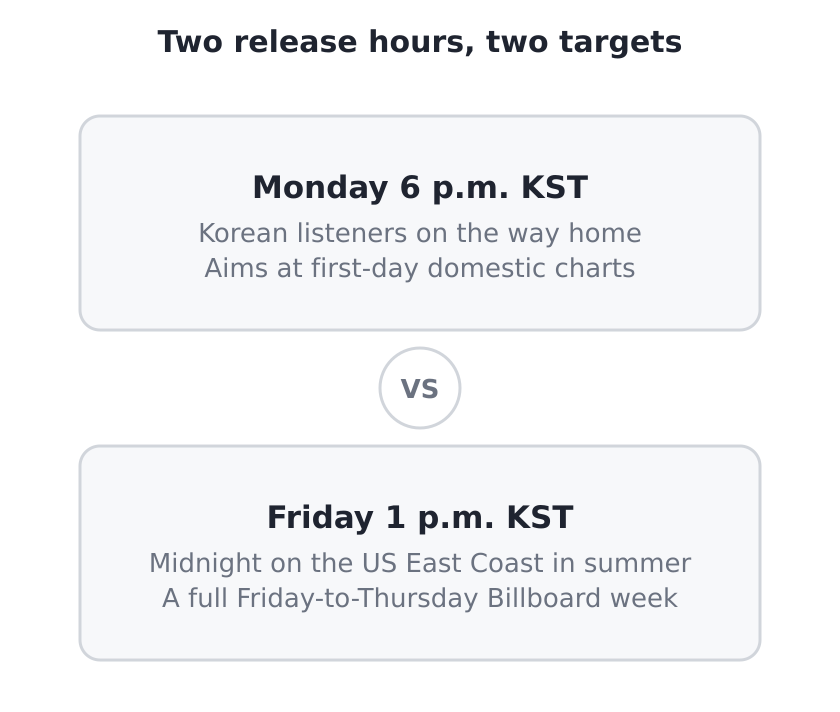
If you want to guess which market a comeback is aiming at, I’d check the release hour before looking at a single teaser. Newsen also pointed out that ENHYPEN’s January album came out at 2 p.m. and the August one at 1 p.m., both timed to New York midnight, one hour apart because of daylight saving time.
Sources
- Standard Korean Language Dictionary: 컴백 (Korean)
- Star News: PLAVE starts promotion for October 12 comeback (Korean)
- SportsQ: what a music show pre-recording is, 2019 (Korean)
- Hankook Ilbo: the long road to a pre-recording, 2018 (Korean)
- Newsen via Nate: release hour and which chart a K-pop album targets, August 2026 (Korean)