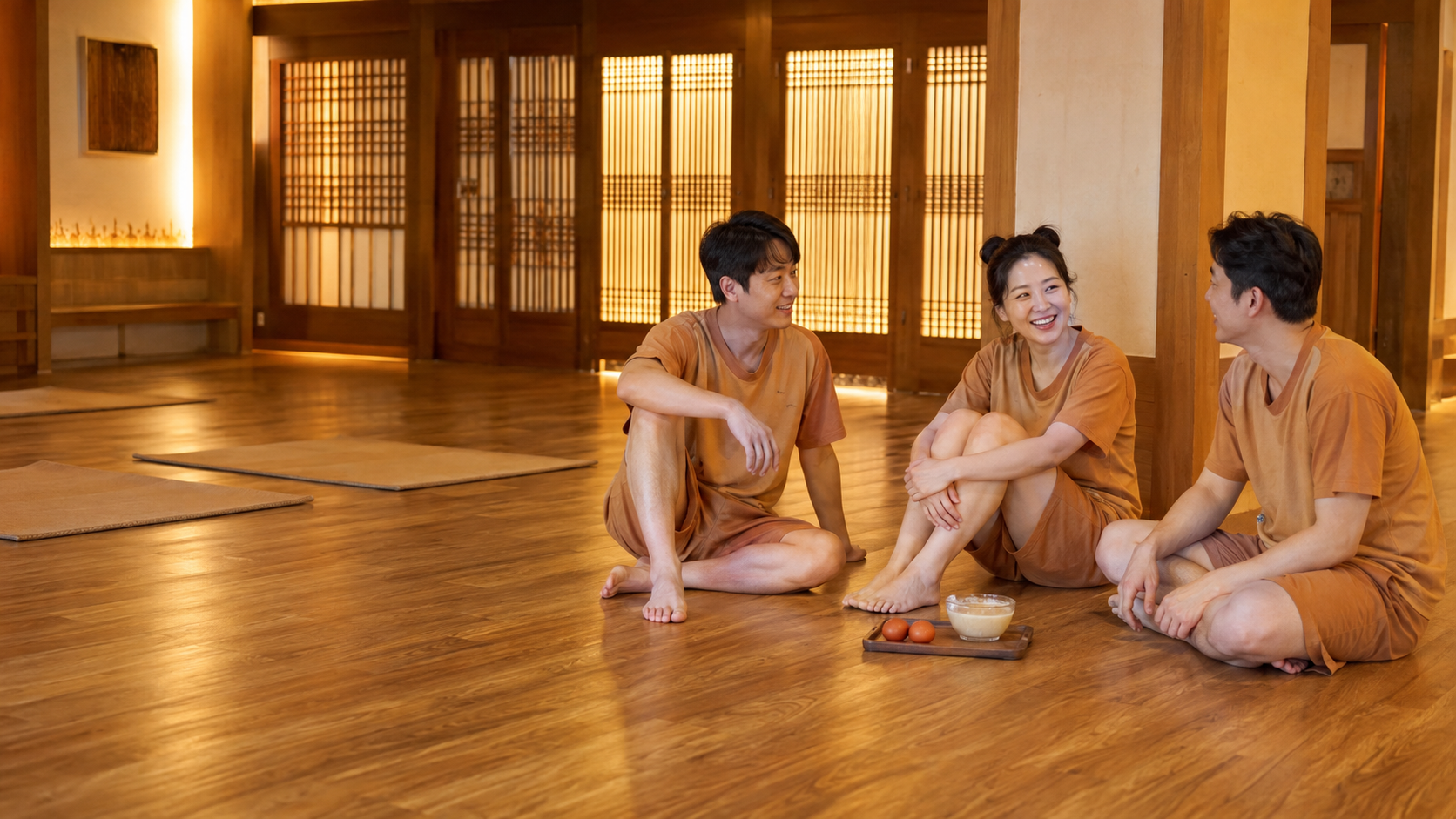
Korean has two everyday words for a public bath, and they don’t mean the same place. A mogyoktang (목욕탕, “bath house”) is where you get clean. A jjimjilbang (찜질방, roughly “heat-therapy room”) is where you get clean, put on the shirt and shorts the front desk handed you, and then stay for hours on a heated floor with a lot of strangers dressed exactly like you.
That shirt is the whole difference, and honestly it’s the reason to go. If the place near your hotel just says sauna on the sign and has no shared floor, you’ve found a mogyoktang. Nothing wrong with it. It’s just not what people mean when they tell you to try a jjimjilbang.
The order you do things in
Shoes come off first and go into a small locker by the entrance. You pay at the desk and get a key, usually on a wristband, along with the clothes. The bath side is split by gender and it’s nude. Shower before you get into any of the pools.
After the bath you dry off, change into the issued clothes, and go up or down to the shared floor, where men and women mix. At a lot of places the wrist key also works at the snack bar, the massage chairs, and even a coin karaoke room. I’d ask at the desk how those get billed before you start tapping it on everything.
The shared floor beat the neighborhood bath
This format took over in the early 2000s, and you can see it in the numbers. Hankook Ilbo’s 2023 analysis of licensing data found Korea’s bathhouse count peaked in 2003 at 9,919, and from 2004 through 2022, closures beat openings every single year. An official at the Korea Bath Industry Association told the paper jjimjilbangs multiplied in the early 2000s and the competition started pushing older bathhouses out by the mid-2000s. People were also moving from long soaks to quick showers.
It hasn’t stopped. Health ministry figures reported by Hankyung in April 2026 counted 5,656 licensed bath businesses in 2025, a category that covers both bathhouses and jjimjilbangs, down from 8,904 in 2000. Energy costs are the latest problem, since heating water and hot rooms all day isn’t cheap. The same report found that places with big jjimjilbang floors are drawing foreign tourists while small neighborhood baths close, and that many places are struggling to keep running 24 hours.
That last part matters if an old guide told you a jjimjilbang is a cheap place to spend the night. Check the hours of the exact place before you plan a night around it.
What to do once you’re in the shirt
Start in the cooler rooms. The usual advice for first-timers is 30 to 40°C (86 to 104°F), and the hottest room isn’t a test you’re supposed to pass. I don’t get people who treat it like one. If you feel dizzy, get out and drink water.
Then go to the snack bar. The classic order is sikhye (식혜, a sweet rice drink), served cold with a few grains of rice floating in it, and roasted eggs with brown shells. I think the eggs are better than they have any right to be.
You’ll probably also see someone with a towel rolled into little sheep horns on their head. That’s a yangmeori (양머리, “sheep head”). It’s completely optional, and I find it weirdly charming. After that, the rest of the afternoon is kind of up to you: lie on the heated floor, nap, keep your voice down near the people who are napping.
Someone at one Seoul bathhouse summed up the split for Hankyung’s reporters in April: the “K-Pop Demon Hunters” effect, they said, is only a story about the big places.