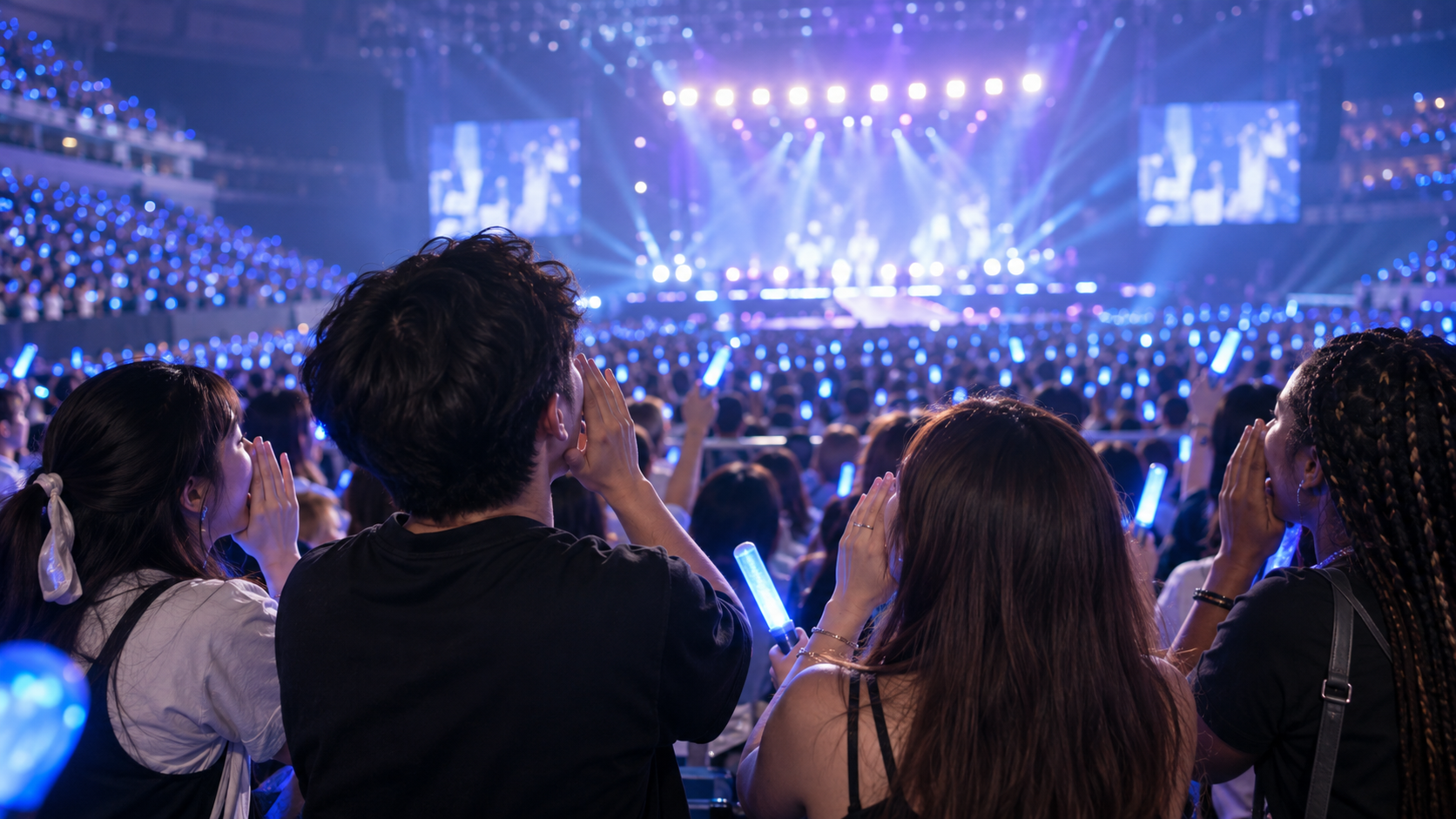
NCT 127 released their album BLINGY at 6 p.m. Seoul time on Monday, August 24, 2026. The eungwonbeop (응원법, “cheering method”) notice for the song BLINGY went up on Weverse at 6:20. That’s the fanchant guide, so the crowd’s part came out twenty minutes after the music did.
The notice itself is two sentences. It asks fans to follow the attached image, shout only the parts marked in color, and hold back any cheers that aren’t in the guide. I kind of love that last request. It’s crowd control, written very politely.
What’s actually on the sheet
The image is the song’s lyrics with color laid on top. The intro shows a count from one to nine in gray and then the group’s name, written in Korean, in orange. Orange brackets with “Hey hey,” “Oh oh oh,” and the name again sit at the ends of lines. Blue picks out a handful of echo lines like “Bring the heat.” Whole verses have no color at all.
A 2024 paper in Frontiers in Psychology, about BTS fans during livestream concerts, defines a fanchant as something fans recite together during a performance, built from bits of the lyrics, the group and member names, or other words. It adds that fans are expected to get the official instructions for the likely setlist and practice before the show.
BTS set that homework on a bigger scale. A Weverse notice on April 2, 2026 posted fanchant guides for 14 songs from ARIRANG and asked fans to bring the noise at the venue.
Korean has a word for the result, ttechang (떼창, “crowd singing”). Jungwon Kim’s chapter in The Oxford Handbook of Pop Music, published in April 2026, treats ttechang as the sound that makes a K-pop live show what it is, and goes as far as calling it a new pop form built for audience participation. I honestly think that’s fair.
Pansori had a courtesy rule first
That Frontiers paper also says fanchants come from chuimsae (추임새, “shouts of encouragement”), calls like “eolssigu” that a drummer and listeners throw in during pansori.
The National Gugak Center’s online dictionary explains where those calls go. Listeners call out right after a great bit of singing or where there are no lyrics, and the no-lyrics spots are deliberate, so the shouts don’t bury the words. In the jinyangjo rhythm that often means the fifth and sixth beats.
The entry also counts the audience as one of pansori’s three essential parts, with the singer and the drummer, and says a performance without listeners isn’t really pansori.
I can’t tell you whether whoever made the BLINGY sheet had pansori in mind. But shouts parked at the ends of lines follow the same courtesy, and I think that’s enough to take the paper’s claim seriously.
That entry has a couple of rules I didn’t expect. You don’t use honorifics in a chuimsae, even when an elder or your own teacher is the one singing. And there’s a whole list of names for chuimsae that get in the way, including the mosquito-sound kind and the funeral-house kind.
Where the two part ways
The dictionary entry also quotes the drummer Kim Myung-hwan saying a real chuimsae slips out before you know it, and a “good!” you say because you’re supposed to doesn’t have the right sound.
A fanchant guide wants the opposite. Every shout is planned in advance, down to its color on the lyric sheet, and nothing gets added.
Sources
- Weverse: NCT 127 “BLINGY” fanchant notice, August 24, 2026 (Korean)
- Weverse: BTS “ARIRANG” fanchant notice, April 2, 2026 (Korean)
- Newsen via Nate: release hours of August 2026 comebacks (Korean)
- Frontiers in Psychology: “Audience reconstructed,” 2024
- Jungwon Kim, “Ttechang: The K-pop Live Scene across Listenership and Musicianship,” Oxford Handbook of Pop Music
- National Gugak Center dictionary: 추임새 (Korean)