
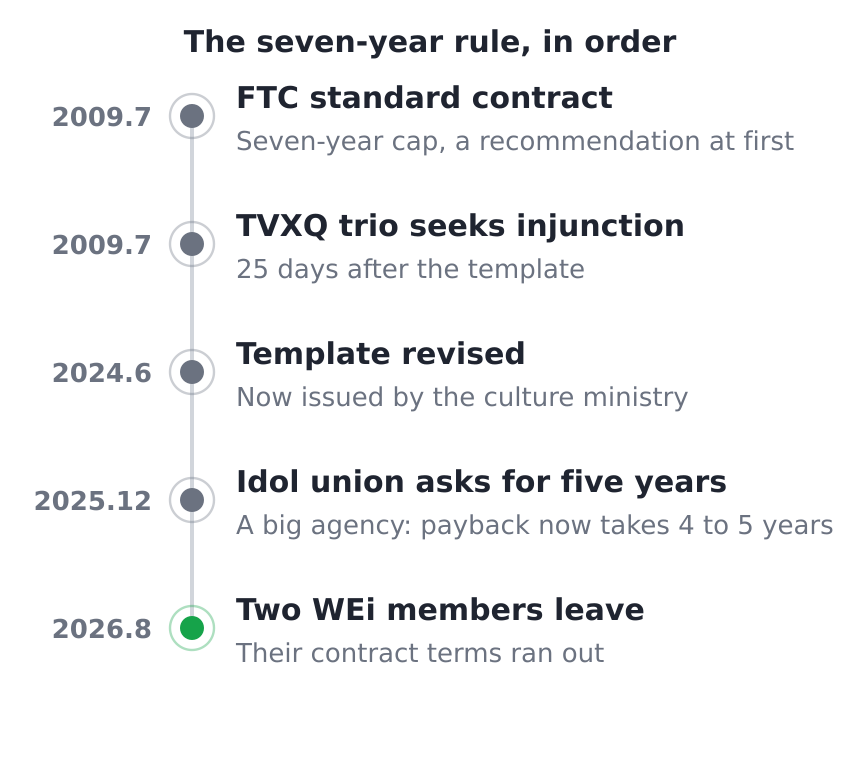
The lawsuit that usually gets credited with K-pop’s seven-year contract came after the rule. Korea’s Fair Trade Commission announced its standard exclusive contract for singers on July 6, 2009. Three TVXQ members filed for an injunction against SM Entertainment on July 31, twenty-five days later.
Korean articles still tell the two stories together, and I get why. That TVXQ contract is the example that makes the rule make sense. Bizhankook’s 2024 series described a thirteen-year term, heavy penalties, and a revenue clause that paid the members nothing unless an album sold more than 500,000 copies. People called it a noye gyeyak (노예계약, “slave contract”).
The number sits in Article 3
The template is issued by the Ministry of Culture, Sports and Tourism these days, and the version I’m quoting is its June 2024 revision. Article 3 says the term of a jeonsok gyeyak (전속계약, “exclusive contract”) can’t exceed seven years. The same paragraph lets the agency and the singer extend it if both agree in writing.
It didn’t start out as a requirement, either. Munhwa Ilbo reported in 2023 that the template was only a recommendation at first and plenty of agencies refused to use it. It spread quickly once JYP Entertainment adopted it.
Why year seven turns into a negotiation
Koreans have a name for what tends to happen next: the seven-year jinx, well-known groups ending around their seventh year. Munhwa Ilbo traced the jinx straight back to the contract term and quoted the head of a mid-sized label. The way that quote puts it, a group that lasts seven years is making money, the members’ say grows with it, and when the two sides can’t line up at renewal, the group ends.
So when a statement says a contract ended at expiration, I read it as a renewal talk that didn’t close. The wording doesn’t claim anything more than that.
WEi is a recent case. On August 25, 2026, their agency said Kim Dong-han and Yoo Yong-ha were leaving by mutual agreement as their contract terms ran out, after long discussions. TV Report noted the two had been at the company for twelve years. On September 4 the agency said WEi would keep going as a team.
The fight now is over the length itself. In December 2025, Dailian quoted the head of the idol labor union saying the term should drop to five years. That article also quoted a big-agency source saying groups now take until year four or five after debut to earn back their launch costs, up from year two or three.
The announcement that is actually news
A mid-term exit reads very differently in Korea. The word to look for is gacheobun (가처분, “provisional injunction”), as in an artist asking a court to suspend a contract before the term is up. That’s what the TVXQ members filed in 2009, and I think “parts ways” is a bad English translation for it.
One exception sits in Article 3 itself. The term gets extended by the time an artist can’t work because of military service, pregnancy, childbirth and childcare, graduate school or study abroad, or a hospital stay of 30 days in a row that has nothing to do with the job. For a boy group, year seven on paper can land well after year seven on the calendar.
Sources
- Ministry of Culture, Sports and Tourism: standard exclusive contract for singers, 2024 revision (Korean, PDF)
- Korea Policy Briefing: FTC announces standard exclusive contracts for entertainers, July 2009 (Korean)
- Hankook Ilbo: three TVXQ members file for injunction against SM, August 2009 (Korean)
- Bizhankook: what changed after the TVXQ case (Korean)
- Munhwa Ilbo: how the seven-year standard contract came about (Korean)
- Dailian: the seven-year contract dilemma, December 2025 (Korean)
- TV Report: WEi’s Kim Dong-han and Yoo Yong-ha end contracts (Korean)
- SPOTV News: WEi to continue as a team (Korean)
- Standard Korean Language Dictionary: 가처분 (Korean)